

A sloped yard doesn’t have to be a headache. In fact, some of the most beautiful gardens I’ve ever seen started with an awkward hillside and a little creative thinking. Whether your slope is gentle or steep, there are practical, budget-friendly ways to make it look intentional — even spectacular.
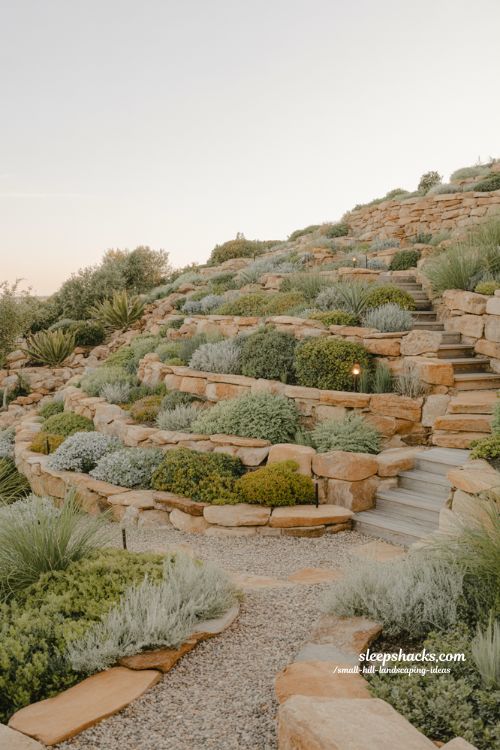
Here’s what you’ll take away from this guide:
- Erosion solutions that double as design features
- Low-maintenance planting strategies that work with gravity, not against it
- Budget-friendly options alongside investment-worthy upgrades
1. Split Your Hillside Bed in Two With a Central Path
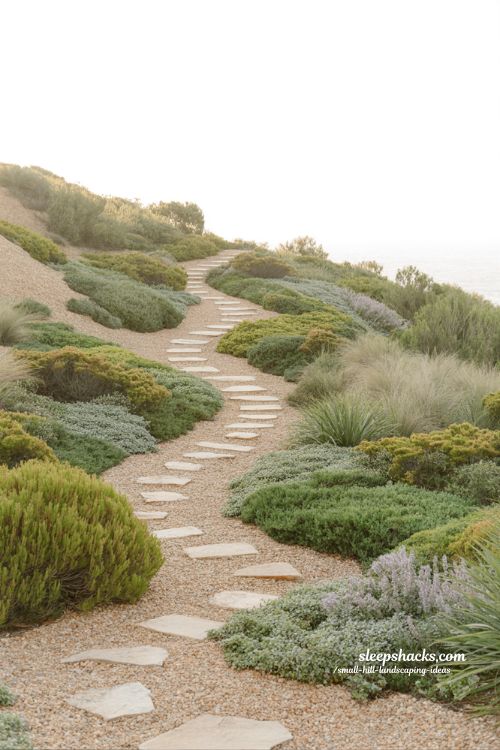
One of the smartest small hill landscaping ideas is simply cutting your hillside bed in half with a pathway or staircase. This gives you access to the middle of the slope — which makes weeding, planting, and pruning so much easier — and breaks up what could otherwise feel like an overwhelming wall of greenery.
Think of it as designing for your future self. I always recommend low-maintenance plants like ornamental grasses, creeping thyme, or drought-tolerant natives for hillside beds. They soften the edges of the path and spill beautifully over stones without needing constant attention.
- Choose flat stepping stones or compacted gravel for the path surface — both handle runoff well
- Plant low, spreading groundcovers along path edges to prevent soil from washing onto the walkway
- Use contrasting plant heights on each side of the path to create visual interest and depth
2. Install Terraced Garden Beds to Tame a Steep Slope
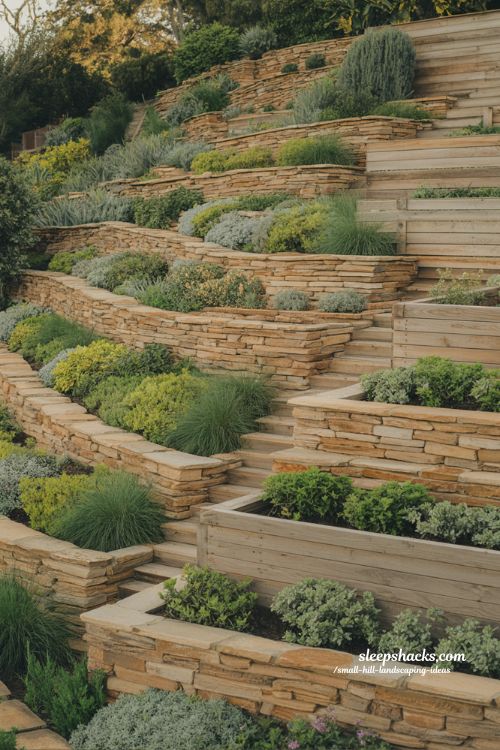
Terracing is one of the most effective — and visually striking — ways to handle a sloped backyard. By cutting the hill into a series of flat “steps,” you create usable planting beds while dramatically reducing erosion. Stone terraces have a timeless, classic quality that only gets better with age, while timber terraces offer a warmer, more rustic look at a lower upfront cost.
The genius of terracing is that it works at almost any scale. A gentle rise of three feet can be transformed with two or three simple tiers; a dramatic hillside might call for five or six levels of varying heights. Either way, you end up with defined planting zones that are much easier to water, fertilize, and maintain than a raw slope.
- Use pressure-treated landscape timbers for a budget-friendly terrace that lasts 10–15 years
- For a permanent, premium finish, dry-stack stone retaining walls look stunning and require no mortar
- Plant each tier with a different color palette to create a layered, garden-party effect when everything blooms
3. Break Up the Slope With Lateral Grass Paths
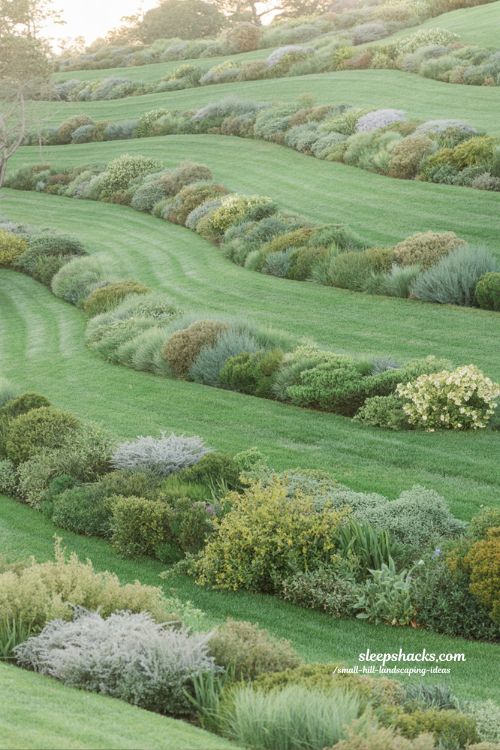
If you love a lush, naturalistic garden look, consider breaking your hillside planting beds with horizontal bands of turf. These grass paths serve double duty: they give you somewhere to walk while tending the slope, and they visually divide a tall planting area into more manageable sections that don’t overwhelm the eye.
This works especially well on shallow slopes where mowing is still practical. You get the soft, green texture of lawn without committing your entire hillside to grass — which can be tricky to maintain and mow safely on anything steeper than about 15 degrees.
- Keep grass bands at least 2–3 feet wide so they’re comfortable to walk on
- Edge the grass strips cleanly where they meet planting beds to prevent encroachment
- Choose a hardy, wear-tolerant grass variety since these paths will get foot traffic
4. Plant a Low-Lying Groundcover to Hold the Soil
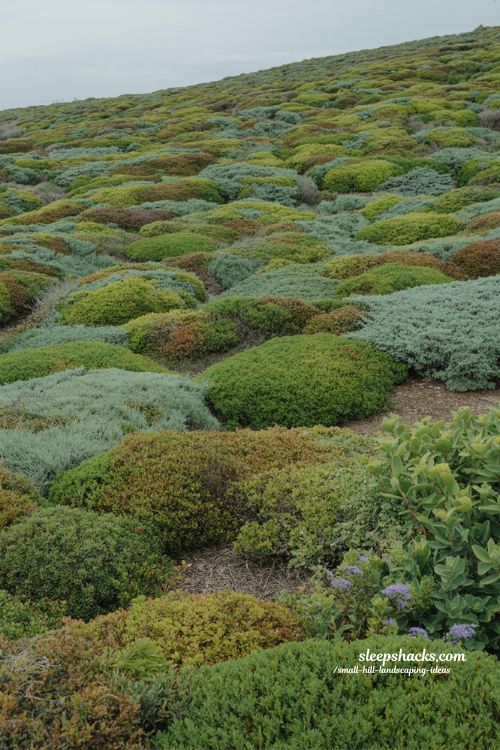
Groundcover plants are the unsung heroes of hillside landscaping. Their dense, fibrous root systems grip the soil like a net — dramatically reducing erosion — while their spreading habit means they fill in gaps and crowd out weeds over time. This is one of the most budget-friendly small hill landscaping ideas, because you can start small and let the plants do the spreading work for you.
Great options include periwinkle (Vinca minor), creeping juniper, ice plant, violet, and ajuga. Each of these thrives in different light conditions, so figure out whether your slope gets full sun, part shade, or deep shade before you buy. Once established, most groundcovers need minimal watering and virtually no fertilizing.
- Plant groundcovers in staggered rows rather than straight lines for a more natural, organic look
- Mulch between new plants until they fill in — this prevents weeds and retains moisture during establishment
- Mix two or three groundcover varieties for textural contrast and a more interesting composition
5. Anchor Hillsides With Large Boulders
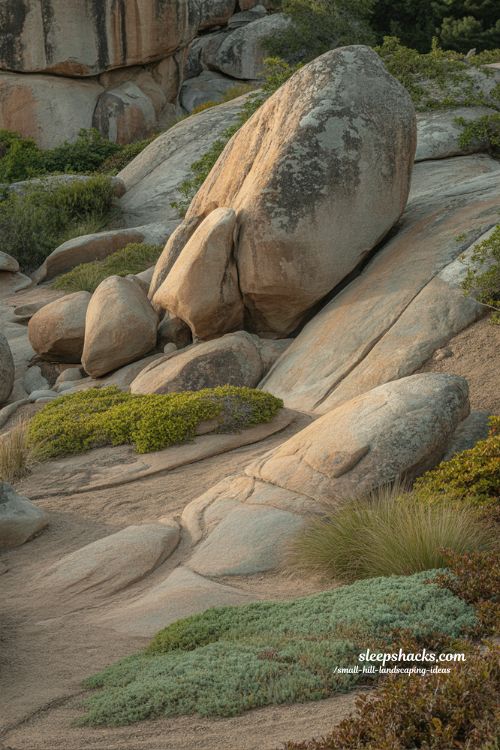
Boulders might be the most low-maintenance landscaping element that exists. Once they’re placed, they never need watering, fertilizing, pruning, or replacing. On a hillside, they do real work: anchoring soil, redirecting water flow, and creating natural-looking focal points that give the slope a sense of permanence and character.
The key is placement. Boulders should look like they belong there — as if the land simply revealed them, rather than someone dropped them in. Partially burying each boulder (at least one-third underground) achieves this effect and actually anchors them more securely against erosion and gravity.
- Use an odd number of boulders — groups of three or five look more natural than pairs or even clusters
- Vary boulder sizes for visual depth; mix one statement piece with several smaller companions
- Tuck low groundcovers or ornamental grasses around boulder bases to integrate them into the planting
6. Layer Fieldstones to Prevent Mulch Washout
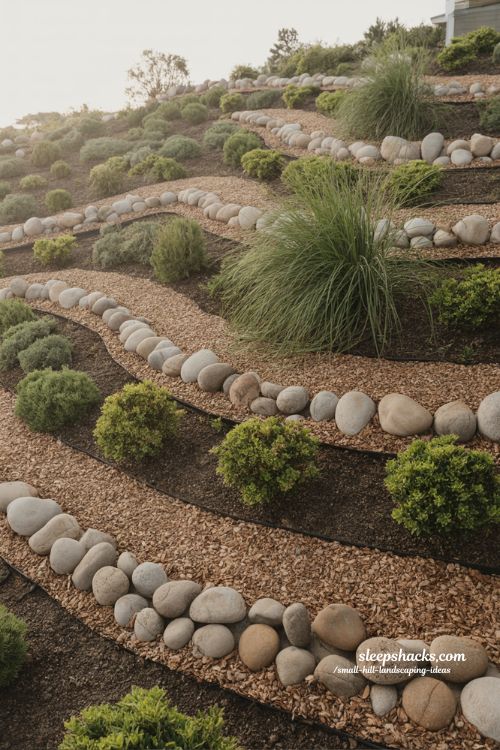
Keeping mulch on a hillside is one of the most frustrating parts of sloped garden maintenance. Every heavy rain seems to wash it straight to the bottom. The fix is surprisingly simple: a single layer of rounded fieldstones or river rocks laid along the natural contour of the slope acts as a physical barrier that holds mulch in place while adding a polished, finished look.
You don’t need an elaborate retaining wall for this — just enough stone to break the flow of water and anchor the mulch layer. Two to three rows of rounded stones stacked loosely along the slope’s middle section can make a dramatic difference in how much mulch you lose after a rainstorm.
- Use rounded river rocks rather than sharp-edged stones, which are more likely to shift
- Place stones perpendicular to the direction of slope to maximize their ability to catch mulch and soil
- Lay landscaping fabric beneath the mulch layer before placing stones for added weed suppression
7. Work With Nature and Add a Water Feature
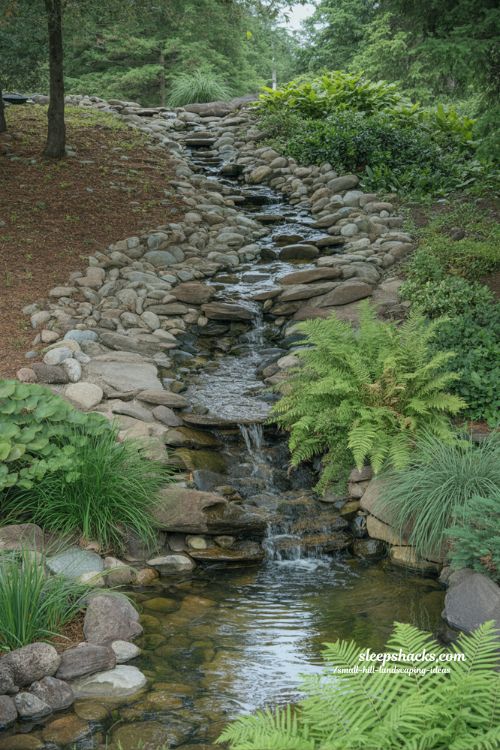
Here’s a perspective shift that changes everything: a sloped yard is the ideal site for a water feature. Gravity does the hard work for you. Water naturally wants to flow downhill, so placing a waterfall, fountain, or cascading stream on a hillside requires far less earthmoving and engineering than installing one on a flat yard.
This is one of those small hill landscaping ideas that can genuinely take a backyard from nice to breathtaking. The sound of moving water adds an entirely new sensory dimension to the garden, and the visual movement draws the eye in a way that static planting simply can’t replicate.
- Line a natural channel in the slope with river rocks to create a dry creek bed that carries rainwater beautifully
- For a true waterfall, work with a landscape contractor to hide the pump and recirculation line within the slope
- Surround the water feature with moisture-loving plants like ferns, astilbe, and hostas for a lush, natural edge
8. Mix Up Plants for Color, Height, and Disease Resistance
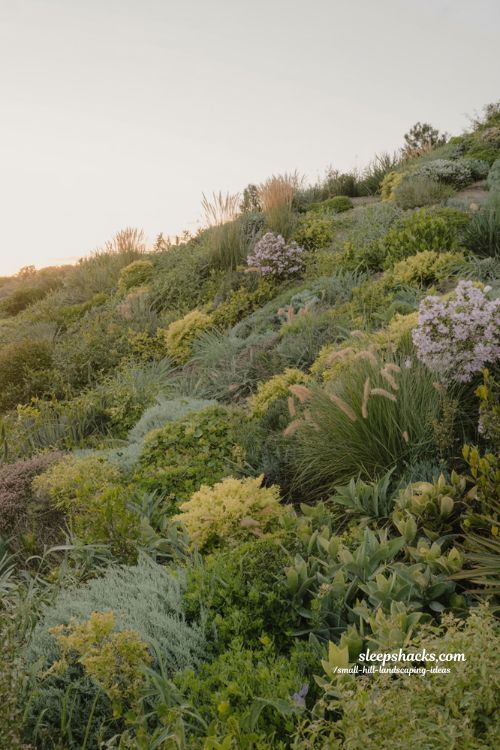
Think of your hillside as a canvas — and a single-species planting as painting it one flat color. Mixing plants of different heights, textures, leaf sizes, and bloom times creates a living tapestry that looks stunning across every season. Practically speaking, plant diversity also protects you: if one species gets hit by disease or pests, you won’t lose the entire slope.
I love combining tall ornamental grasses for movement, mid-height flowering shrubs for structure, and low groundcovers for the base layer. The contrast between bold, strappy grass foliage and delicate flower clusters is endlessly pleasing — and the combination works hard to suppress weeds and stabilize soil at the same time.
- Plan for year-round interest: spring bulbs, summer perennials, fall-color shrubs, and evergreen groundcovers
- Choose native plants where possible — they’re adapted to local rainfall and rarely need supplemental watering
- Include at least one plant with winter interest (seed heads, berries, or evergreen foliage) so the slope never looks bare
9. Tame Steep Drops With a Retaining Wall
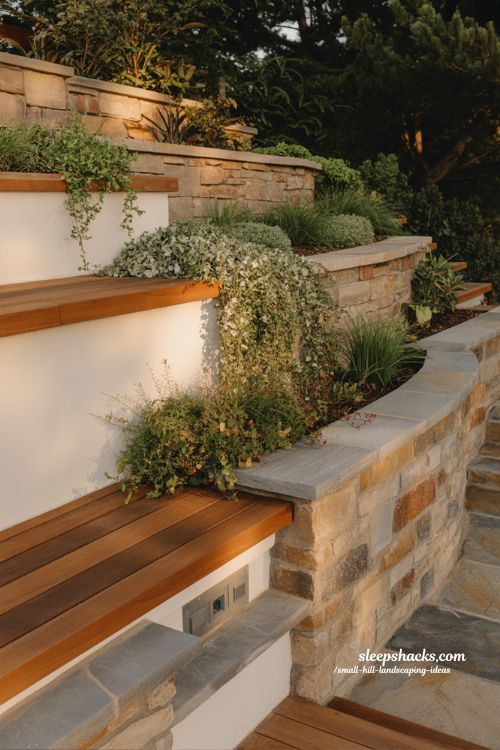
When your slope has an abrupt grade change — especially anything over 20 percent — a retaining wall isn’t just a design choice, it’s a structural necessity. The good news is that retaining walls can be genuinely beautiful. Stone block walls have a timeless, cottage-garden quality; poured concrete has a clean, modern edge; timber walls have warmth and rusticity that suits naturalistic gardens perfectly.
For walls over four feet tall, most municipalities require a building permit and an engineer’s sign-off — so check local regulations before you dig. For walls under three feet, a confident DIYer can often handle the installation with the right materials and drainage prep.
- Always install gravel backfill and perforated drainage pipe behind a retaining wall to prevent hydrostatic pressure buildup
- Cap stone walls with flat capstones or a contrasting material to give them a finished, intentional look
- Plant the top of the wall with trailing plants like creeping phlox or creeping Jenny that spill over the edge
10. Plant Grass on a Manageable Slope
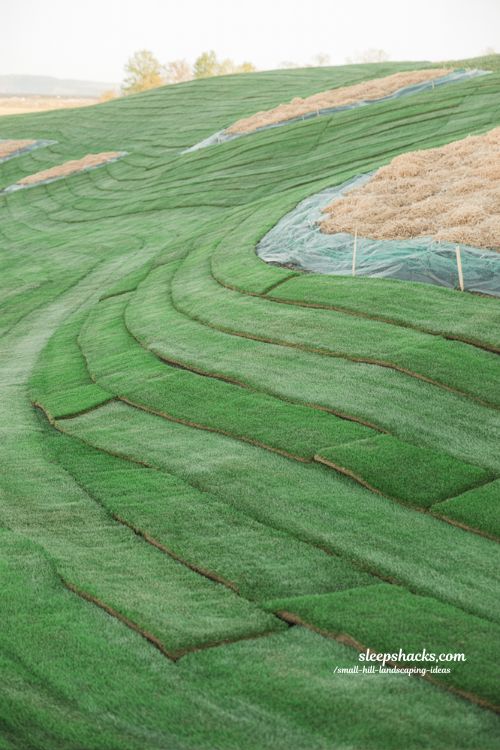
Grass on a slope is absolutely doable — you just need to be strategic about it. The critical threshold is grade. Most riding lawnmower manufacturers recommend a maximum slope of 15 degrees; beyond that, push mowing or alternative groundcovers become much safer and more practical choices.
If your slope is within the mowable range, choose a grass variety specifically marketed for slopes — these tend to have more aggressive root systems that establish faster and hold better. Sod is more expensive than seed but gives you near-instant erosion control, which is valuable on a hillside where bare soil is vulnerable to every rainstorm.
- Lay sod perpendicular to the slope direction and use sod staples to hold it in place during establishment
- For seeding, cover with erosion-control netting or straw matting to keep seed in place while it germinates
- Water new grass gently and frequently — heavy irrigation on a slope will wash seed or sod downhill
11. Integrate a Garden Shed Into a Tall Retaining Wall
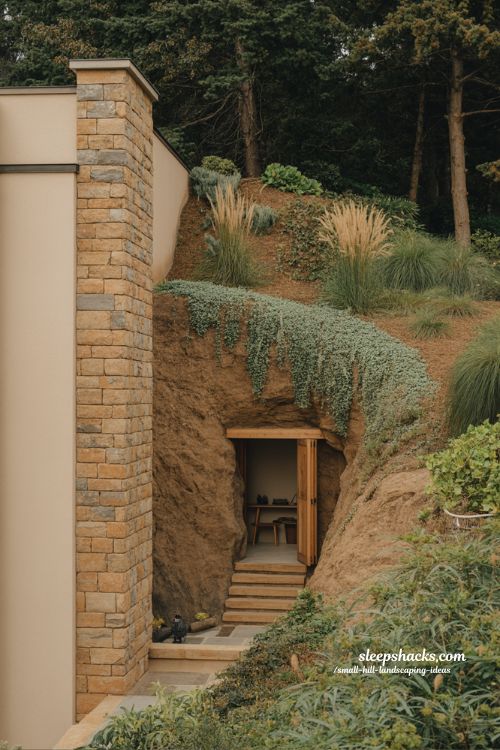
When you’re building a tall retaining wall, why not put that excavated space to work? Tucking a garden shed directly into the hillside behind the wall creates storage space that seems to appear out of nowhere — no footprint added to your yard, no awkward outbuilding cluttering the view. The shed becomes part of the landscape rather than an afterthought.
This is one of those ideas that feels almost architectural, and it works beautifully in both rustic and contemporary settings. Pair a stone-faced retaining wall with a timber shed door for a storybook cottage effect, or go clean and modern with concrete walls and a steel door.
- Make sure the shed has proper drainage — hillside moisture is significant, and a poorly drained shed will rot quickly
- Use the shed roof as a planting surface if it’s accessible — a green roof or tray of sedums looks incredible
- Light the shed entrance with low-voltage path lights to make it functional and visually dramatic after dark
12. Use Stone Slab Steps for a Luxurious Garden Feel
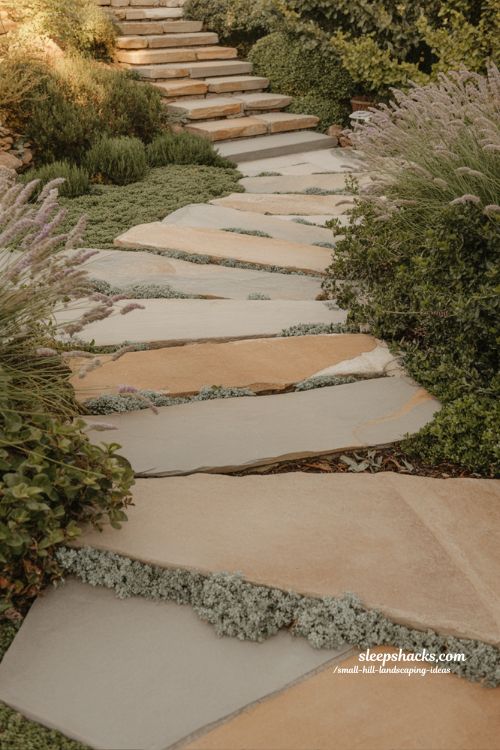
When your slope calls for stairs, stone slabs are one of the most beautiful choices you can make. Wide, deep stone steps — each slab perhaps 18 to 24 inches deep — feel generous and luxurious underfoot. They slow you down in the best way, inviting you to pause, look around, and appreciate the garden on your way up or down.
The naturalistic quality of stone slabs is hard to replicate with any other material. Each slab is slightly different in color and texture, and over time they acquire a patina of moss and weathering that makes them look as though they’ve always been part of the landscape.
- Set each slab with a slight backward pitch (toward the slope) so rainwater drains away from the step face
- Leave small gaps between slabs and plant creeping thyme or Irish moss in the crevices for a romantic, cottage look
- Edge the staircase with low ornamental grasses or lavender for a fragrant, finished border
13. Install a Switchback Path for a Gentle Grade
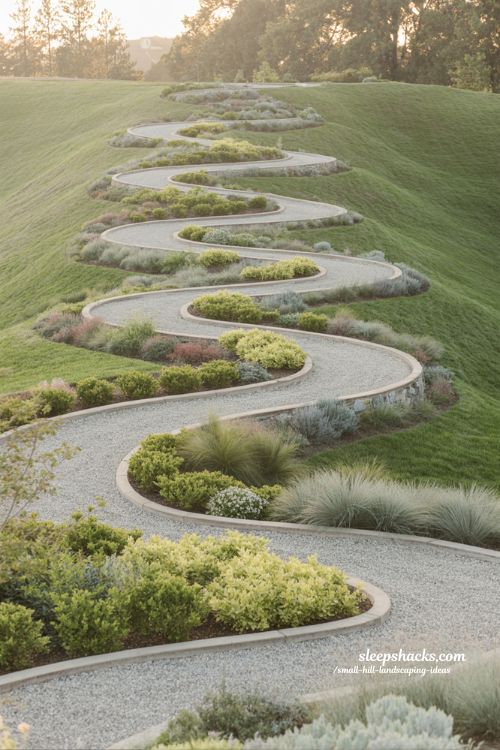
A switchback path is one of those small hill landscaping ideas that solves a real problem beautifully. By zigzagging across the slope rather than going straight up it, a switchback reduces the effective grade dramatically. What might be a steep, breathless climb becomes a pleasant, meandering walk. The path also adds visual complexity and draws the eye across the whole hillside rather than straight up.
Materials matter here. Decomposed granite compacts well and handles slopes nicely; gravel stays in place with proper edging; stepping stones through groundcover give a casual, garden-path feel. Choose what suits your overall aesthetic.
- Keep switchback turns gentle and wide — tight hairpin turns become awkward to navigate
- Plant the inside of each curve with slightly taller plants to create a sense of arrival at each turn
- Use the switchback’s zigzag structure to create distinct planting “rooms” between each leg of the path
14. Work in Levels to Unlock a Steep Slope’s Potential
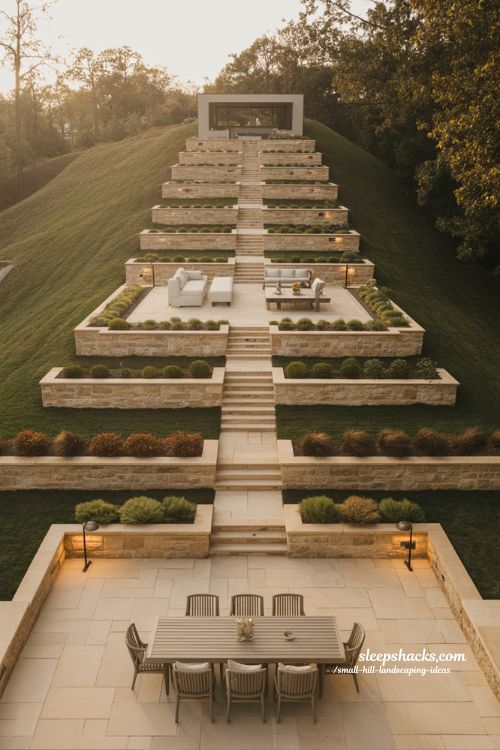
A dramatically steep hillside is, counterintuitively, a tremendous design opportunity. By working in distinct zones or levels — each with its own purpose and character — you can transform what feels like an impossible slope into a multi-layered outdoor living space that would be the envy of any flat yard.
Picture it: a dining patio at the base, a lounging area at mid-slope connected by wide stairs, and a quiet seating alcove at the top with a view back over the whole garden. Each level becomes its own destination, and the movement between them becomes part of the garden experience.
- Define each level clearly with consistent materials (the same stone, the same paving) to unify the overall design
- Vary the size of each level — a mix of intimate and open spaces keeps the journey interesting
- Add lighting at each transition between levels for both safety and dramatic nighttime effect
15. Glue Your Mulch Down on the Steepest Slopes
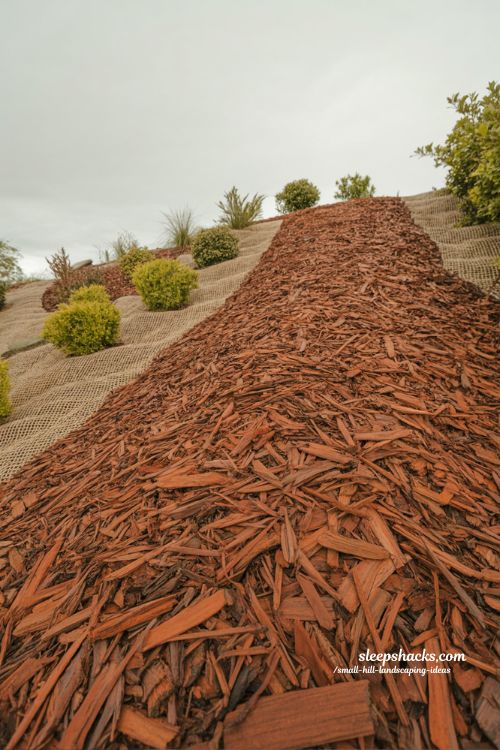
Here’s one of the cleverest practical tricks in hillside landscaping: mulch glue. Yes, it’s exactly what it sounds like — a liquid adhesive that you spray or pour over a freshly laid mulch bed to bond the pieces together and hold them in place on even the steepest slopes. It’s safe for plants, biodegrades naturally, and keeps your beautiful mulch layer exactly where you put it.
Combine mulch glue with jute or coir netting laid beneath the mulch for a belt-and-suspenders approach to erosion control that genuinely works. This combination is especially effective on newly planted slopes where the plants haven’t yet established the root systems needed to anchor soil on their own.
- Apply mulch glue on a dry day when no rain is forecast for at least 24 hours
- Use gorilla hair mulch (shredded redwood or cedar) as your base layer — its fibrous texture grips naturally even before the glue is applied
- Reapply glue each spring as part of your regular mulch refresh routine
Hillside Landscaping: A Quick Cost & Effort Comparison
| Idea | Approximate Cost | DIY-Friendly? | Maintenance Level |
| Groundcover planting | $200–$800 | Yes | Low |
| Mulch + erosion netting | $100–$400 | Yes | Low |
| Fieldstone layering | $300–$900 | Yes | Very Low |
| Timber terracing | $500–$2,000 | Intermediate | Low |
| Stone slab steps | $1,000–$4,000 | Intermediate | Very Low |
| Retaining wall (under 3 ft) | $800–$3,000 | Intermediate | Very Low |
| Retaining wall (over 4 ft) | $3,000–$10,000+ | Hire a Pro | Very Low |
| Water feature | $2,000–$10,000+ | Hire a Pro | Medium |
Best Plants for Small Hill Landscaping by Condition
| Plant | Sun Requirement | Root Depth | Best Use |
| Creeping juniper | Full sun | Deep | Large slopes, erosion control |
| Periwinkle (Vinca) | Part shade | Moderate | Shaded hillsides |
| Ice plant | Full sun | Shallow | Dry, sunny banks |
| Ornamental grasses | Full sun | Deep | Structure and movement |
| Creeping phlox | Full sun | Shallow | Wall tops, rocky slopes |
| Ajuga | Part to full shade | Shallow | Shaded, moist slopes |
| Dwarf forsythia | Full sun | Moderate | Shrub layer on gentle slopes |
| Ferns | Full shade | Shallow | Deeply shaded, moist hillsides |
Frequently Asked Questions
How do I stop soil erosion on a steep hillside without spending a fortune?
The most budget-friendly erosion control combination is landscaping fabric topped with gorilla hair mulch, secured with jute or coir netting. Add rounded fieldstones in horizontal bands across the slope to act as physical barriers for mulch and soil. Over time, establish deep-rooted groundcovers like creeping juniper or ornamental grasses — once they’re settled, their root systems become the most effective erosion control you can have.
What plants are best for a small hill garden in a shady location?
Shaded slopes actually have a beautiful plant palette available. Ajuga, ferns, hostas, periwinkle, and astilbe all thrive in low-light conditions and have root systems capable of holding hillside soil. For additional structure, consider adding shade-tolerant shrubs like summersweet or mountain laurel, which provide height and seasonal interest alongside the lower groundcovers.
Can I plant a vegetable garden on a hillside?
You can, as long as the slope isn’t too steep. Plant vegetables in rows running perpendicular to the slope (across the hill, not up it) to slow water runoff and reduce erosion. Root vegetables like carrots and radishes anchor themselves well; leafy greens like lettuce do beautifully in partially shaded hillside spots. Terracing is the best long-term solution for a productive hillside vegetable garden — each flat tier becomes its own raised bed.
Is it safe to mow grass on a sloped yard?
It depends on the grade. Most riding lawnmower manufacturers set a maximum safe operating angle of around 15 degrees. For steeper slopes, a push mower — which is more bottom-heavy and stable — is a safer choice, and it should be operated across the slope (horizontally) rather than up and down it. For very steep grades, groundcovers or mulch beds are genuinely safer and more practical than trying to maintain turf.
How do I choose between a retaining wall and terracing for my slope?
It comes down to how abrupt your grade change is. A sharp, vertical drop of more than a foot or two calls for a retaining wall, which holds back that vertical face of soil. Terracing works better across longer, more gradual slopes where you want to create a series of flat planting areas rather than hold back a single drop. In practice, many hillside gardens use both — a retaining wall at the base and terracing across the mid-slope — to address grade changes at different heights.