

A sloped backyard can stop you in your tracks before you’ve even started. The quotes come back high, the terrain looks impossible, and suddenly that hillside feels less like a backyard and more like a problem that costs money just to look at.
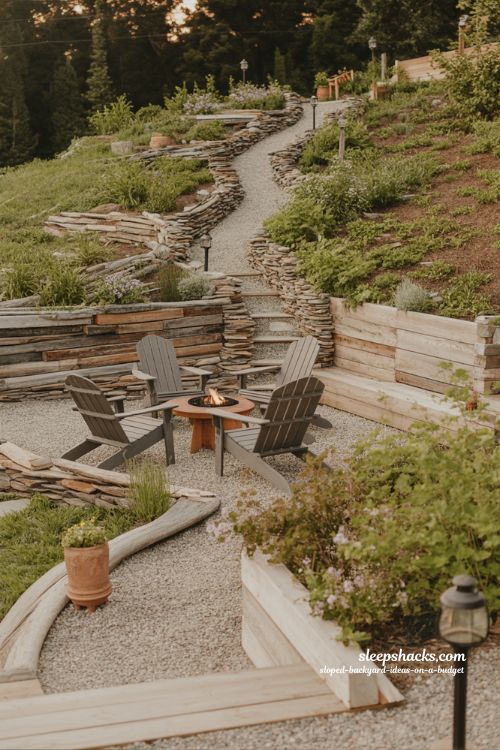
But here’s what most homeowners don’t realize: a slope is one of the most naturally dynamic canvases you can work with outdoors.
These sloped backyard ideas on a budget will show you exactly how to work with the grade rather than flattening it into submission. Whether you’re dealing with a gentle lean or a serious drop, affordable fixes exist — and many of them look better than expensive professional installs.
What you’ll get from this guide:
- DIY terracing and retaining methods using cheap or free materials
- Plant-based erosion control that costs under $400 and maintains itself
- Practical layout ideas for seating, paths, and drainage on any slope
1. Turn Your Slope Into Terraced Garden Beds for Under $300
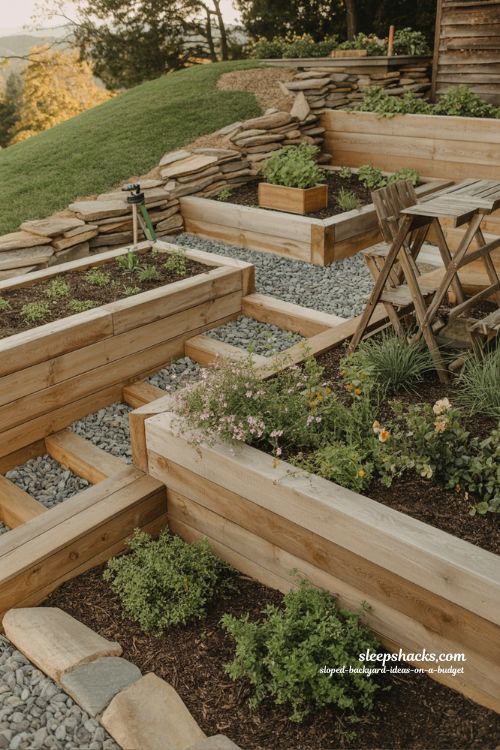
Terracing transforms an unusable hillside into something genuinely beautiful. By carving the slope into flat, stepped levels, you stop soil movement and create defined planting zones. Timber sleepers, cinder blocks, and reclaimed stone all work well as retaining edges — and sourced second-hand, they cost very little.
Each terrace level can serve a different purpose: herbs closest to the house, flowering perennials in the middle, native shrubs anchoring the base. Fill each tier with quality topsoil, cover with mulch, and plant immediately to stabilize. This is one of the most satisfying sloped backyard ideas on a budget because the results are dramatic and the process is manageable for most weekenders.
- Source reclaimed timber or stone from salvage yards, Facebook Marketplace, or demolition sites
- Always backfill behind retaining edges with gravel for drainage before adding soil
- Start with the lowest terrace first and work upward — it’s easier and safer to build this way
2. Use Creeping Ground Covers to Stop Erosion Naturally
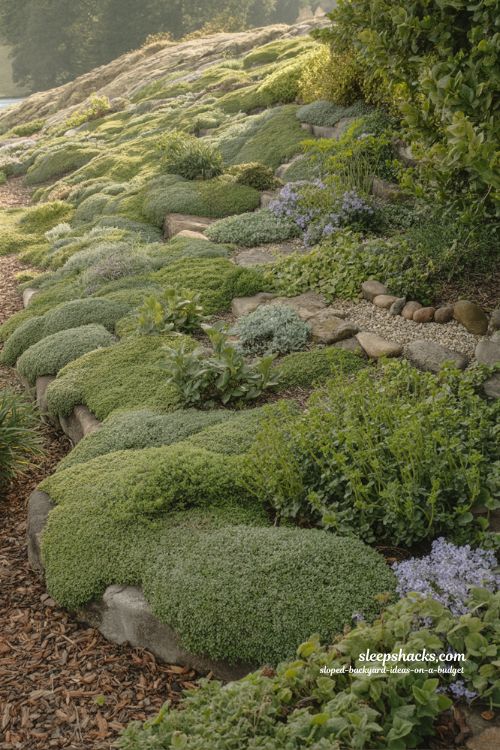
Ground covers do the quiet, essential work of holding a slope together. Plants like creeping thyme, vinca, periwinkle, and pachysandra spread quickly, root deeply, and require almost nothing after establishment. At $2–$4 per plant in bulk flats, covering a full slope costs a few hundred dollars at most.
Plant along contour lines rather than rows running straight up and down the hill — this slows water flow and prevents channeling. Within a single growing season, bare soil disappears under a dense, weed-suppressing carpet that stabilizes the grade permanently. One of my favorite sloped backyard landscaping solutions because it genuinely gets better every year without any extra effort.
- Choose species suited to your slope’s sun exposure — thyme for full sun, pachysandra for shade
- Buy in bulk flats from wholesale nurseries to cut per-plant cost significantly
- Mulch between plants in the first season to retain moisture while root systems establish
3. Build DIY Stone Steps That Double as a Design Feature
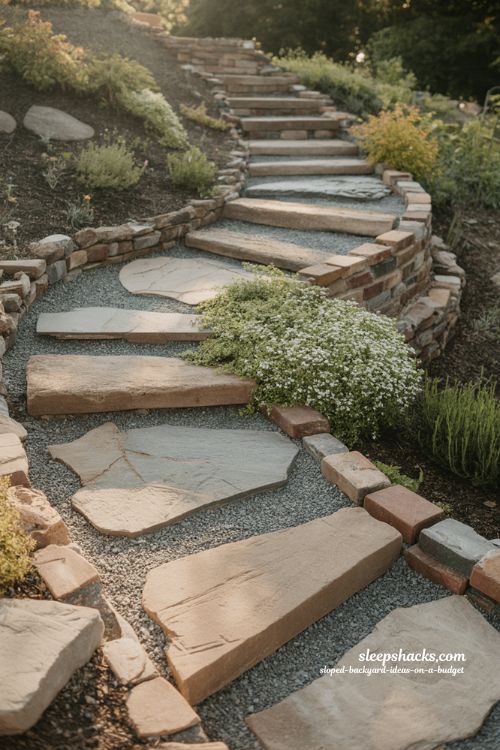
Stone steps are where function meets character on a sloped yard. Collected fieldstone, broken concrete slabs, or reclaimed brick all build solid, attractive steps for very little money — total materials often run under $150 for a typical residential project.
Set each stone on a compacted gravel base for drainage and stability. Edge with low-growing thyme or creeping phlox to soften the edges over time. The handmade, irregular quality of natural stone steps adds a warmth and permanence that poured concrete simply doesn’t have — and once they’re in, they’re in for decades with zero maintenance.
- Dig a shallow base for each stone and pack gravel beneath before setting
- Vary stone sizes slightly for a natural, organic look rather than a rigid engineered feel
- Plant low ground cover along the edges within the first season to anchor the surrounding soil
4. Plant a Wildflower Meadow on a Steep Hillside for $100 or Less
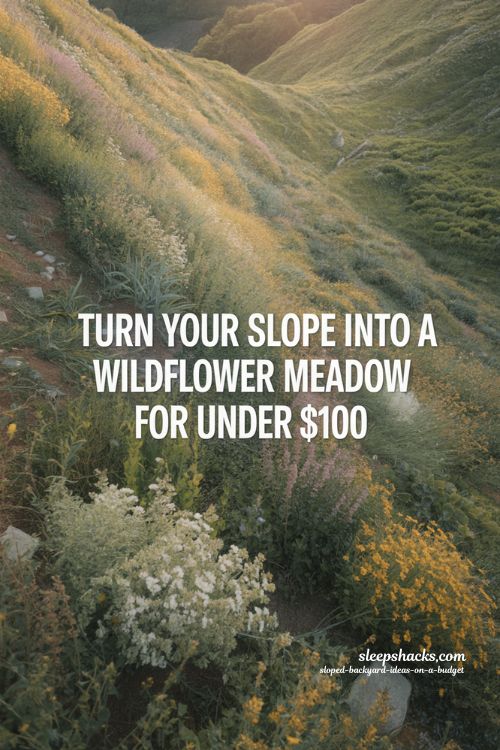
Few things look more effortlessly beautiful than a wildflower meadow cascading down a slope — and few things cost less. Native seed mixes run $50–$100 for a quarter-acre, and once established, these deep-rooted plants stabilize soil, eliminate mowing, and support pollinators all season long.
Clear existing weeds, broadcast seed in fall or early spring, and water lightly until the plants take hold. After the first season, rainfall handles everything. This is the lowest-effort entry point into hillside landscaping ideas on a budget — and the payoff in color and ecological value is genuinely hard to beat for the investment.
- Choose regional native mixes that include species naturally suited to hillside conditions
- Fall seeding works best — seeds stratify over winter and germinate strongly in spring
- Avoid disturbing the slope once seeded; foot traffic before establishment sets back germination
5. Repurpose Railroad Ties for Rustic Terraced Retaining Walls
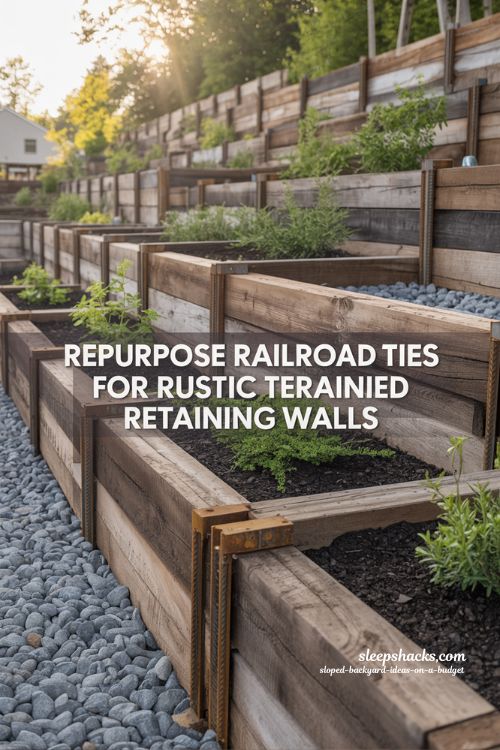
Used railroad ties from salvage yards cost $10–$20 each — a fraction of new landscape timber prices. These heavy beams handle serious retention on steep slopes while their weathered texture adds instant, authentic character to any sloped backyard landscaping project.
Anchor with rebar driven through drilled holes deep into the hillside, step each layer back slightly for stability, and fill behind with compacted gravel and topsoil. This is one of those budget hillside landscaping ideas that looks more expensive than it is, especially once planting softens the raw timber edges through the first season.
- Pre-drill holes before driving rebar — it keeps ties from splitting under the force
- Step terraces back at least two inches per course for structural stability on steeper grades
- Use pressure-treated timber if reclaimed railroad ties aren’t available in your area
Cost Comparison: Budget Retaining Methods
| Method | Cost Per Linear Foot | Durability | Best For |
| Railroad Ties (used) | $3–$6 | 15–20 years | Rustic, naturalistic yards |
| Cinder Blocks | $4–$8 | 30+ years | Modern or industrial styles |
| Dry-Stacked Stone | $2–$10 | 20–50 years | Natural, cottage aesthetics |
| Gabion Baskets | $8–$15 | 25+ years | Contemporary, bold designs |
| Reclaimed Brick | $1–$4 | 20–30 years | Vintage, heritage gardens |
These figures assume DIY labor. Add $20–$50 per linear foot if hiring a contractor for installation.
6. Create a Winding Mulch Pathway Through Your Slope
Switchback paths make steep slopes safe to navigate and look intentional doing it. Hardwood mulch or wood chips cost $30–$50 per cubic yard, making this one of the most affordable sloped backyard ideas for improving accessibility without any structural work.
Edge the path with salvaged branches, log rounds, or inexpensive landscape edging to keep mulch contained. Zigzag the route gently — this slows descent, reduces erosion along the path, and creates a meandering feel that’s far more inviting than a straight shot up a hill. Replenish annually and the path practically maintains itself.
- Keep path width at 36–42 inches minimum for comfortable, safe passage
- Slope each path section slightly (1–2%) toward the downhill side to shed rainwater naturally
- Install landscape fabric beneath mulch to suppress weeds along the full path length
7. Add a Gravity-Fed Water Feature Using Your Slope’s Natural Pitch
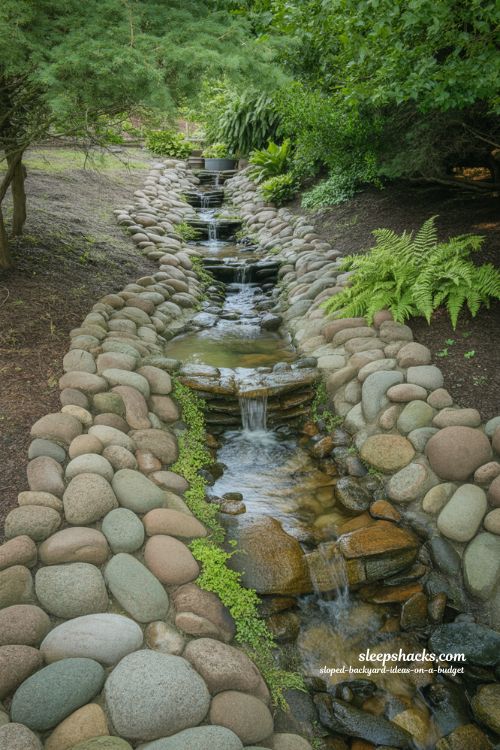
A slope is a natural waterfall waiting to happen. Position a simple boulder-lined stream along an existing drainage path and gravity does all the work — no expensive pump infrastructure needed for gentle flows. Materials for a basic cascading feature run $300–$800 total.
Use stones of varying sizes to create naturalistic flow, add small catch basins to slow water velocity at intervals, and edge with moisture-loving ferns or hostas. This transforms runoff from a problem into a feature — and there’s something genuinely calming about the sound of moving water in a backyard that no other landscaping element replicates.
- Always position along existing drainage paths — never force water to flow uphill or sideways
- Add a small reservoir at the base to recirculate water if you want the feature to run in dry periods
- Plant moisture-tolerant species along the edges within the first season to lock in the banks
8. Plant Ornamental Grasses for Year-Round Slope Texture
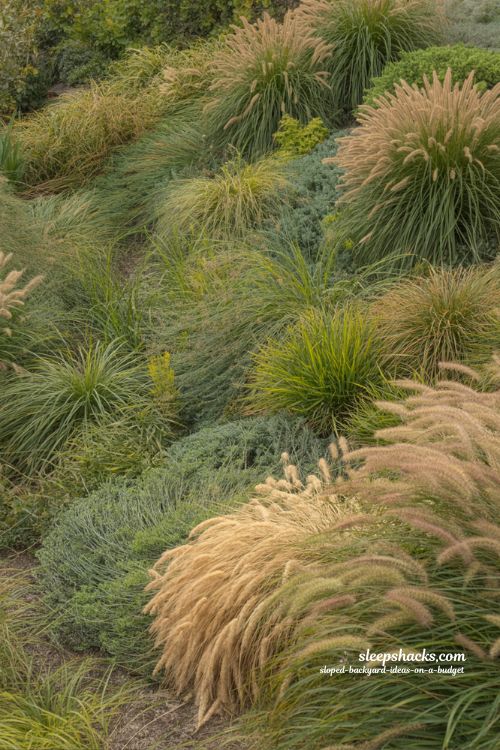
Ornamental grasses are workhorses for sloped backyard landscaping on a budget. At $8–$20 per plant, varieties like fountain grass, miscanthus, and native switchgrass stabilize soil with fibrous root systems while providing four seasons of visual interest — movement in summer, warm color in fall, structure in winter.
Space plants according to mature size and let them naturalize over time. By year two or three, a mass planting fills in completely and handles erosion control almost entirely on its own. They’re drought-tolerant once established, deer-resistant in most regions, and ask almost nothing from you after the first growing season.
- Choose clumping varieties over running types to prevent invasive spread on slopes
- Cut back to 4–6 inches in late winter before new growth emerges for clean seasonal renewal
- Mix in native perennials between grass clumps for additional erosion-control depth
Budget Planting Guide for Sloped Backyards
| Plant Type | Cost Per Plant | Erosion Control | Maintenance Level | Best Slope |
| Creeping Thyme | $2–$4 | High | Very Low | Full sun, gentle–moderate |
| Ornamental Grass | $8–$20 | Very High | Low | Sun or part shade, any grade |
| Native Shrubs | $10–$20 | Very High | Low after establishment | Any exposure, steep slopes |
| Wildflower Mix | $50–$100/quarter acre | Moderate–High | Minimal | Full sun, moderate–steep |
| Creeping Juniper | $15–$30 | High | Very Low | Full sun, steep slopes |
| Sedum/Sempervivum | $4–$8 | Moderate | Very Low | Full sun, rocky, dry |
9. Build Gabion Baskets for a Modern Budget Retaining Wall
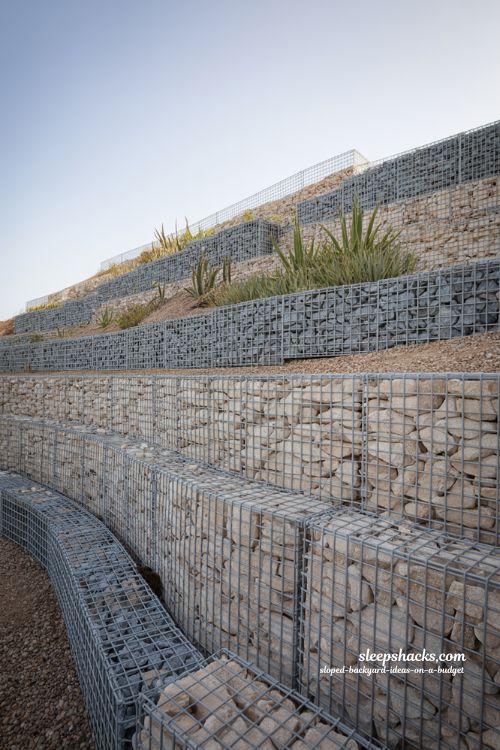
Gabion wire cages filled with locally sourced rock create striking modern retaining walls that cost a fraction of masonry. DIY baskets run $30–$60 each; rocks can often be sourced free or cheaply from local quarries or rural properties. A complete installation costs $500–$1,000 versus $5,000+ for a professional stone wall.
Stack cages securely, fill uniformly for a clean contemporary look or with mixed materials for a more rustic result. Gabions drain naturally, handle frost-thaw cycles exceptionally well, and last decades with zero maintenance. They’re one of the most visually distinctive cheap landscaping ideas for slopes trending in modern yard design right now.
- Use uniform-sized stone for a polished modern look; mixed rubble for a more naturalistic effect
- Secure cages with spiral wire or clips at every connecting edge for structural integrity
- Consider leaving the top course partially open and filling with soil to plant trailing succulents
10. Carve Out a Cozy Seating Terrace on Your Hillside
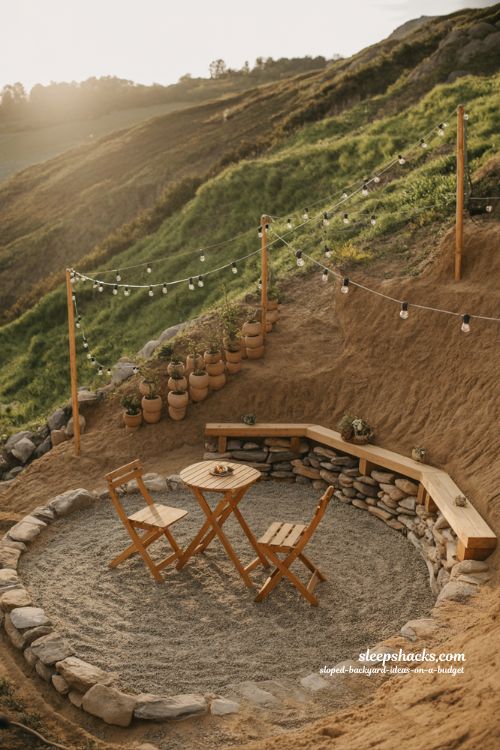
Every sloped backyard deserves at least one level spot to sit and enjoy it. Carving a small terrace and reinforcing it with a simple timber or stacked stone retaining edge costs $200–$400 in materials and transforms an otherwise unusable section of hillside into a genuine outdoor room.
Compact the carved earth thoroughly before laying pavers or pea gravel. Add a small bistro table, some string lights, and a few potted plants, and the space becomes the kind of corner you actually want to spend time in. Hillsides create natural enclosure that flat yards can’t replicate — it feels sheltered and intentional in a way that a patio on a flat lawn rarely does.
- Always compact carved soil in 4-inch layers before laying any surface material
- Face the seating terrace toward your best view or toward morning sun for the most enjoyable use
- Add a simple retaining edge at least 6 inches taller than the finished terrace surface for safety
11. Use Cinder Blocks for Affordable, Long-Lasting Terraces
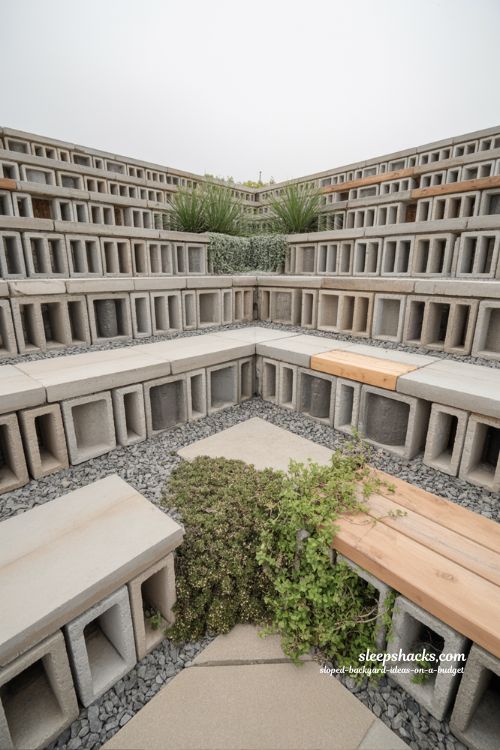
Cinder blocks are among the most underrated retaining materials for sloped backyard ideas on a budget. Widely available, easy to stack without specialized tools, and genuinely durable for 30+ years, they handle serious grade changes on steep slopes without the complexity of mortared masonry or engineered walls.
Stack in a staggered pattern for strength, backfill with gravel for drainage, and cap with flat stone or timber for a finished top edge. Fill hollow cores with soil and plant trailing succulents or creeping thyme for added texture. Paint them to match your fence or leave them raw for an industrial-modern aesthetic — either works.
- Use standard 8×8×16 blocks for straightforward stacking without custom cuts
- Step each course back 1–2 inches from the one below for natural slope and added stability
- Grout the top capstone course in place for a cleaner, more permanent finish
12. Try Reclaimed Brick Terracing for Vintage Charm
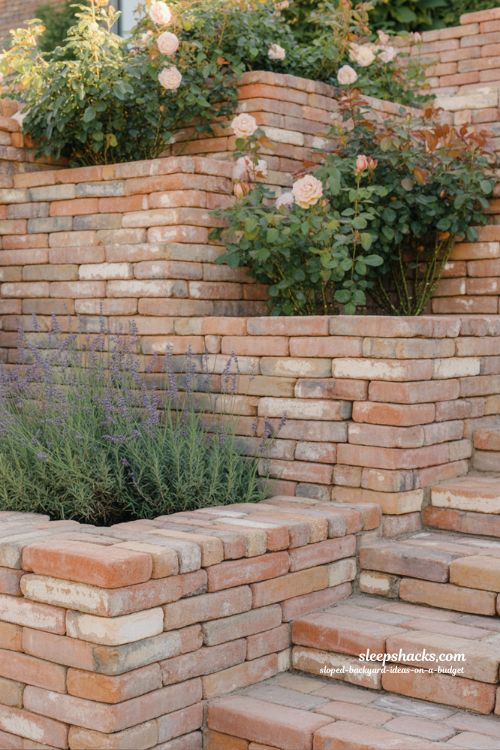
Reclaimed bricks cost $0.25–$1.00 each sourced from demolition sites or online — a meaningful saving when you need quantity for terracing borders and garden edging. Their warm tones and worn texture give sloped backyard landscaping an established, heritage character that new materials simply cannot fake.
Stack dry for flexibility and easy adjustments, or mortar for permanence on steeper retaining applications. Pair with heritage roses, lavender, or cottage perennials for a garden that looks like it grew naturally over decades. It’s one of those sloped backyard ideas that feels timeless rather than trendy — and that’s exactly why it holds up season after season.
- Search Facebook Marketplace, Craigslist, and local demolition companies for free or cheap reclaimed brick
- Clean bricks with a stiff brush before use — old mortar chips can interfere with stable stacking
- Mix brick sizes and tones slightly for a more authentic, handmade appearance
13. Plant Deep-Rooted Native Shrubs for Permanent Slope Stability
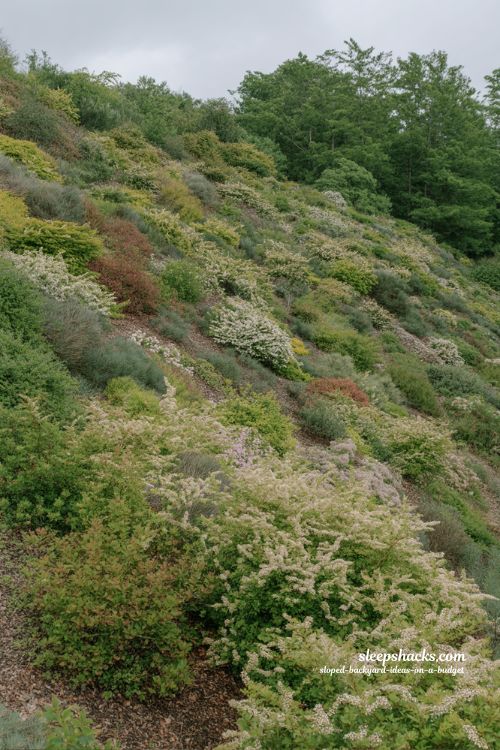
Native shrubs are the long game of hillside landscaping ideas on a budget. Small containerized plants cost $10–$20 each, establish quickly in local conditions, and grow into woody, deep-rooted anchors that hold soil at depth where erosion actually begins. Once established, most require no irrigation, no fertilizing, and minimal pruning.
Mass plantings of spirea, potentilla, native viburnum, or serviceberry create cohesive, finished-looking hillsides that maintain themselves season after season. Buy small and be patient — two growing seasons in, you’ll have a slope that handles itself almost entirely on its own. Lowest-effort, highest-return planting approach for any grade.
- Buy one-gallon containers rather than five-gallon — they establish faster and cost 60% less
- Water weekly through the first summer only; established natives handle drought on their own
- Mix two or three complementary species for visual interest and layered root depth
14. Install a DIY French Drain to Solve Slope Water Problems
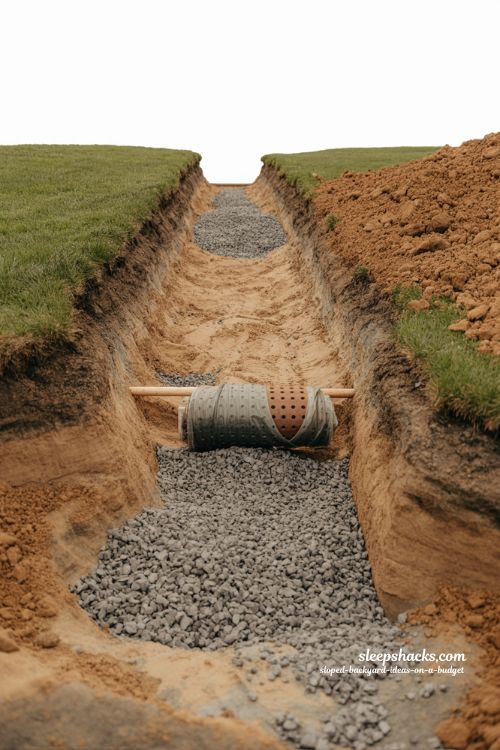
Drainage is the foundation of every other slope improvement you make. A DIY French drain — perforated pipe in a gravel-lined trench — costs $100–$300 in materials and redirects problem runoff before it erodes soil, undermines retaining walls, or damages plant roots. This invisible fix makes everything else last longer.
Direct the outlet toward a rain barrel, dry creek bed, or planted area where the water serves a purpose. Dig the trench along the natural drainage path, line with landscape fabric, fill with gravel and pipe, then backfill. Gravity-powered, zero-energy, and effective for decades with no moving parts to maintain or replace.
- Slope the trench bottom at least 1% (1 inch drop per 8 feet) toward the outlet for consistent flow
- Use sock-wrapped perforated pipe to prevent fine soil particles from clogging the gravel over time
- Mark the outlet location clearly so future landscaping projects don’t accidentally block it
15. Create a Rock Garden with Drought-Tolerant Alpine Plants
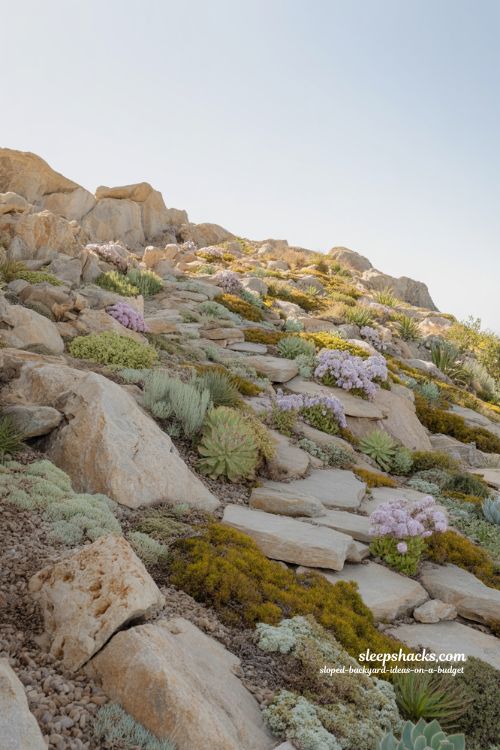
Rock gardens are perfectly suited to slopes — the excellent drainage and sun exposure that make hillsides challenging for lawns are exactly what alpine plants prefer. Collected fieldstone costs nothing; supplemental stone from a local quarry runs under $100. Fill pockets with sedums, sempervivums, and creeping phlox for year-round interest.
Arrange stones to mimic natural outcroppings: partially buried, odd-numbered clusters, varied in size and orientation. Once established, these plants handle heat, poor soil, and neglect with ease. A well-designed rock garden on a budget slope looks genuinely wild and intentional at the same time — a difficult effect to achieve with any other planting approach.
- Bury at least one-third of each boulder below grade for a natural, rooted appearance
- Choose plants with varied bloom times to keep color moving through spring, summer, and fall
- Top-dress the soil between plants with fine gravel — it suppresses weeds and improves drainage
16. Lay Slope Stabilization Mats to Protect New Plantings
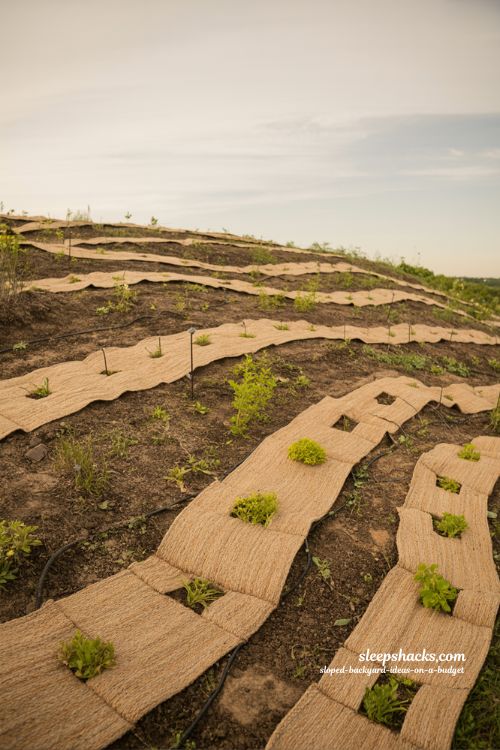
The most vulnerable moment for any slope planting is the establishment period — before roots have set and before plants have filled in. Biodegradable jute or coir matting provides immediate erosion protection during this window, costing $75–$150 per roll and covering significant square footage.
Secure with landscape staples, plant or seed through the openings, and leave the mat in place. As plants mature, the mat decomposes into organic matter that improves the soil below. It’s a one-time spend that dramatically improves the success rate of every other planting on the slope — a worthwhile investment that pays for itself by protecting more expensive plants.
- Overlap mat edges by 6 inches minimum to prevent water from finding gaps between sections
- Use biodegradable staples or cut willow stakes — they won’t become litter as the mat breaks down
- Seed through mat openings immediately after installation for maximum establishment overlap
17. Design a Multi-Level Slope with Mixed Materials on Any Budget
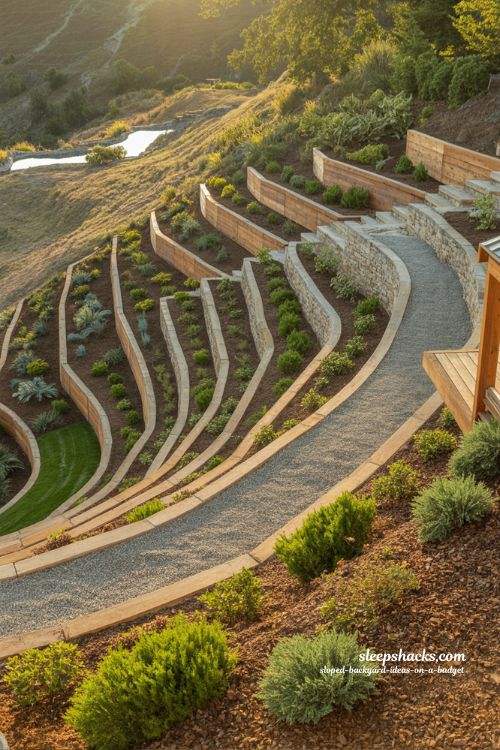
The most satisfying sloped backyard ideas on a budget combine everything: a terrace or two, a winding path, native plants, a small seating nook, and perhaps a simple water feature tucked into a natural drainage line. The key is phasing — tackling one element per season keeps costs manageable and lets each improvement inform the next.
Start with drainage and erosion control, add retaining structure, then layer in planting, paths, and seating. Even a $500–$1,000 total investment spread across two seasons can produce a multi-dimensional outdoor space with genuine personality and lasting appeal. The slope isn’t the problem. It was always the opportunity.
- Sketch a rough layout before starting so each phase connects logically to the next
- Photograph your progress each season — it helps you stay motivated and plan improvements
- Prioritize erosion control in year one; aesthetics are easier to add once the slope is stable
Frequently Asked Questions
What is the cheapest way to landscape a sloped backyard? Ground cover planting is the most affordable starting point — a full slope covered with vinca or creeping thyme costs $200–$400 in plants and stabilizes soil immediately. Wildflower seeding costs even less at $50–$100 for significant areas. Both approaches eliminate the need for expensive hardscape retaining structures, especially on moderate grades.
Can I terrace a steep slope without hiring a contractor? Yes — and many homeowners do it successfully. Used railroad ties, cinder blocks, and dry-stacked stone are all manageable DIY materials that handle serious grade changes. The key is starting with the lowest terrace first, anchoring materials securely with rebar or compacted gravel backfill, and working upward one level at a time across multiple weekends.
How do I stop my sloped yard from eroding without spending a lot? Plant dense ground covers along contour lines, mulch all bare soil, and install a simple French drain if water is concentrating in specific spots. These three steps combined cost under $500 for most yards and address erosion at its root causes — exposed soil, unmanaged water flow, and lack of root structure in the slope.
What plants work best for a sloped backyard on a budget? Creeping thyme, vinca, pachysandra, ornamental grasses, and native shrubs are the most cost-effective choices. They spread to cover large areas, establish without special care, and hold soil with dense root systems. Native plants are particularly smart for sloped backyard landscaping on a budget because they adapt to local conditions and rarely need irrigation after the first season.
How long does it take to transform a sloped backyard on a budget? Most slopes show meaningful improvement within a single growing season if erosion control planting goes in early. A full multi-terrace transformation with paths and a seating area realistically takes two to three seasons when phased for budget. The first season handles stabilization; the second adds structure and aesthetics; by the third, the yard feels finished and intentional.