

There’s something about a Japanese garden that makes you stop and breathe a little slower. Maybe it’s the way raked gravel mimics the movement of water, or the way a single Japanese maple seems to hold an entire season in its leaves. Whatever it is, Japanese garden ideas have captured the imagination of gardeners worldwide — and for good reason. These spaces aren’t just beautiful. They’re intentional in a way that most garden styles simply aren’t.
- Japanese gardens are rooted in over 1,000 years of Buddhist and aristocratic tradition, designed to quiet the mind rather than dazzle the eye.
- Every element — rocks, water, plants, paths — must carry meaning or serve a purpose; decoration without function has no place here.
- Japanese garden design scales beautifully to any size, from a compact urban courtyard to a sprawling backyard landscape.
Why Japanese Garden Design Works for Modern Homes
Japanese gardens work especially well for today’s homeowners because they reward restraint. In a world of maximalist outdoor spaces crammed with furniture, lighting, and colour, a Japanese-inspired garden offers something rare: quiet. The philosophy is simple — everything present must earn its place. Rocks represent mountains. Gravel suggests flowing water. Moss evokes the slow, unhurried passage of time. Once you understand the language, you can create something extraordinary with very little.
| Garden Style | Best For | Maintenance Level | Water Needed? | Key Material |
|---|---|---|---|---|
| Zen (Karesansui) | Small spaces, meditation | Low | No | Raked gravel |
| Stroll Garden | Large spaces, journeys | High | Yes | Paths + pond |
| Tea Garden (Chaniwa) | Entertaining, rituals | Medium | Optional | Stone lanterns |
| Courtyard (Tsubo-niwa) | Urban, compact spaces | Medium | Optional | Moss + stone |
17 Japanese Garden Ideas for Every Outdoor Space
1. The Classic Zen Rock Garden for a Small Backyard

A karesansui, or dry landscape garden, is one of the most powerful Japanese garden ideas for limited space. Using raked gravel and three to five strategically placed rocks, you can create a composition that feels ancient and intentional. Concentric circles in the gravel suggest water rippling from a stone. Parallel curves suggest a flowing river. No water required — just a rake, some patience, and a willingness to embrace the beautiful art of leaving things out.
- Use odd-numbered rock groupings: three, five, or seven stones arranged with clear height differences
- Choose natural granite or sandstone — avoid artificially smooth or coloured decorative rocks
- Re-rake after rain and wind to keep the composition crisp and meditative
2. A Bamboo Water Feature That Brings Peaceful Sound

The shishi-odoshi, or bamboo deer scarer, is one of the most recognisable Japanese garden water features. A bamboo tube slowly fills with water from a small stream, tips when full, releases a satisfying knock against a stone, then resets. That rhythmic, intermittent sound is deeply meditative — and entirely out of proportion with how simple the feature actually is. For small gardens, it delivers maximum atmosphere with minimal footprint and no large pond required.
- Position the feature near a seating area so the sound can be fully appreciated at rest
- Use non-invasive Fargesia bamboo nearby for authentic framing without root spread issues
- Keep the water flow gentle — a slow drip creates better sound rhythm than a fast stream
3. Japanese Maple as a Statement Focal Point

Few plants earn their place in a garden the way a Japanese maple does. Acer palmatum brings structural elegance in every season — deeply cut foliage in spring and summer, fiery crimson in autumn, and a beautifully bare architectural branch structure through winter. In a small courtyard, a single specimen in a glazed pot becomes the entire focal point. In a larger space, a grove of acers creates a woodland understorey of extraordinary, quietly breathtaking beauty.
- Choose ‘Bloodgood’ for rich purple foliage or ‘Sango-kaku’ for vivid coral-red winter stems
- Shelter from cold winds and morning frost — acers dislike waterlogged soil
- Resist the urge to add more plants around it; let the maple breathe and command its space
4. Cloud-Pruned Shrubs for a Sculptural Garden Look

Cloud pruning — known as niwaki in Japan — transforms ordinary shrubs into living sculptures that suggest miniature mountain landscapes. Osmanthus, box, yew, and azalea all take to this technique beautifully. The method involves removing internal growth to expose the branch framework, then clipping outer growth into soft, rounded cloud-like pads. It’s slow, patient work, but the results age magnificently. Even relatively young plants take on the air of ancient specimens with careful, consistent shaping.
- Prune cloud-formed shrubs twice yearly — late spring after the first flush and again in early autumn
- Use sharp Japanese secateurs for clean cuts that heal faster and carry less disease risk
- Start with osmanthus if you’re a beginner — it’s forgiving and clips into beautiful shapes quickly
5. A Stepping Stone Path Through the Garden
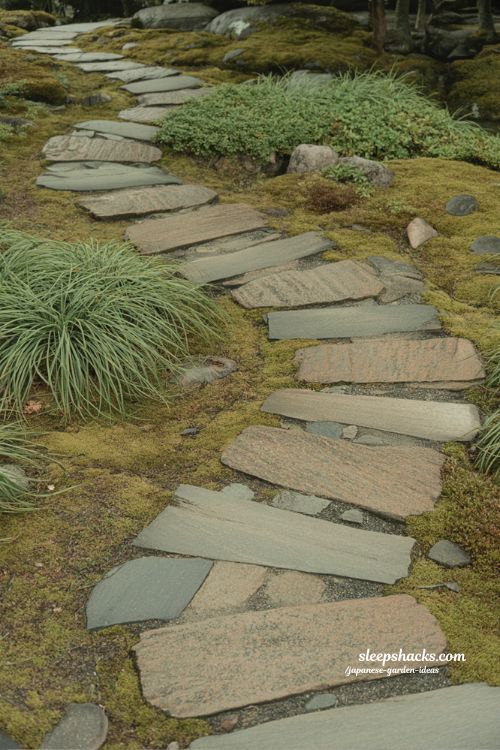
In Japanese garden design, paths are never just functional. They guide visitors through a composed narrative, with each turn revealing a new perspective or planting combination. Stepping stones of natural granite, water-worn pebbles, or weathered timber create texture underfoot that becomes part of the sensory experience. Spacing matters — stones placed slightly further apart slow the pace and encourage observation. The path itself should feel like a quiet journey, not a direct route from A to B.
- Avoid machine-cut uniform slabs — they read as too contemporary for organic Japanese aesthetics
- Partially sink stones into soil so they feel rooted, not recently placed and hovering
- Plant moss or Hakonechloa grass along path edges to soften the transition between stone and soil
6. A Moss Garden Beneath the Trees
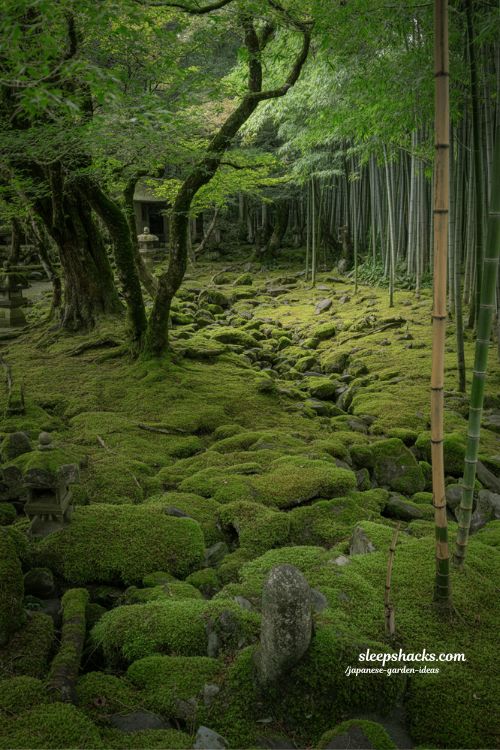
Moss is one of the most powerful and underused elements in Japanese garden design. It carpets the ground with a velvet green that suggests age, moisture, and deep time. Beneath a canopy of acers and bamboo, moss creates a forest-floor tapestry that makes even a newly planted garden feel established and timeless. Varieties like haircap moss and grey fringe moss thrive in shade and moist conditions where little else will grow, making them uniquely practical as well as beautiful.
- Keep moss consistently moist — it browns and crumbles without regular moisture during dry spells
- Remove fallen leaves promptly so they don’t smother the moss or block the light it needs
- Use moss to cover the base of rocks and lanterns, giving them an authentically weathered quality
7. Stone Lanterns Along a Garden Path at Night
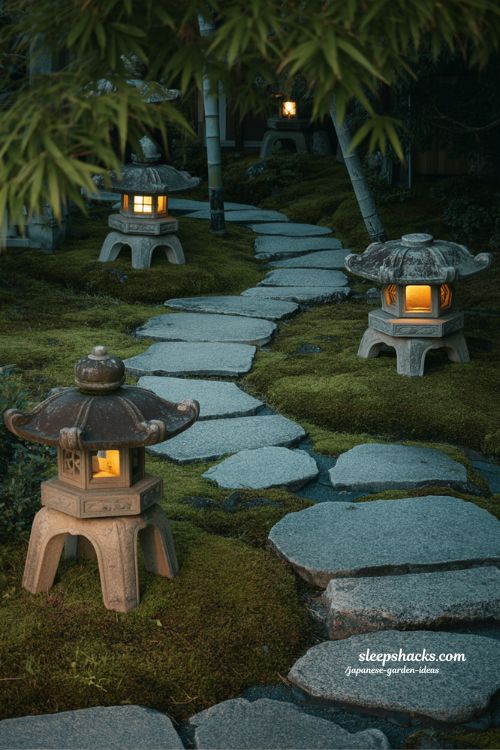
Stone lanterns — called toro in Japanese — serve a purpose beyond lighting. They are architectural anchors that give weight, history, and cultural reference to a garden composition. Placed along a stone path, beside a water feature, or at the edge of a gravel bed, a well-chosen stone lantern carries the same visual weight as a sculpture. At night, with a warm candle or LED light inside, it creates a glow that transforms the garden into something truly magical and quietly beautiful.
- Choose weathered granite lanterns over smooth concrete — texture reads as more authentic and aged
- Position lanterns near water features or path junctions where they have maximum visual impact
- Allow moss to grow naturally on the lantern surface over time — it only improves with age
8. Cherry Blossom Tree for a Seasonal Spectacle
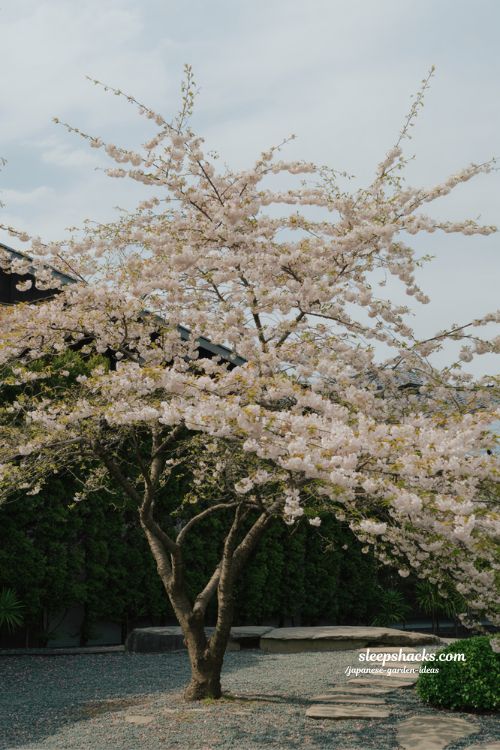
No plant embodies Japanese culture more completely than cherry blossom. The Japanese concept of mono no aware — the bittersweet awareness of impermanence — is embodied in its brief, extraordinary flowering. For large spaces, Prunus ‘Tai-Haku’ delivers spectacular white blossom and genuine presence. For smaller gardens, Prunus subhirtella ‘Autumnalis’ flowers on bare branches through winter with extraordinary delicacy. Either way, a cherry tree positioned against a backdrop of dark evergreens becomes one of the most powerful garden moments of the year.
- Let the blossom stand alone — resist underplanting with competing spring colour
- Prunus serrula is worth considering for small spaces where polished mahogany bark earns its place year-round
- Plant in full sun with well-drained soil for the best flowering performance and overall health
9. Wisteria Trained Over a Pergola or Garden Arch
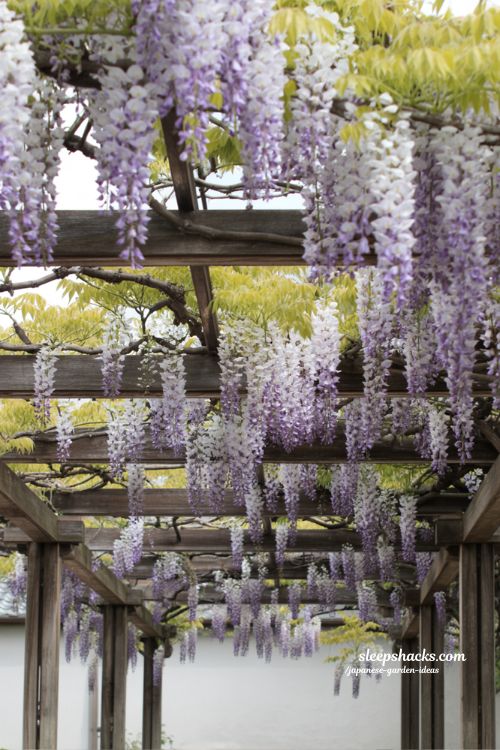
Wisteria floribunda — the Japanese species — produces longer flower racemes than its Chinese counterpart and is one of the most spectacular flowering climbers available for a Japanese garden. Trained over a pergola, bridge, or archway, it creates a cascade of fragrant purple and white in late spring that is simply breathtaking. The key is commitment: wisteria needs twice-yearly pruning to stay controlled. Give it strong support, full sun, and two careful pruning sessions each year and it rewards you magnificently.
- Summer prune in August, cutting back to five or six leaves from the main framework
- Winter prune in February, cutting the same shoots back further to two or three buds
- Never let wisteria grow near gutters, roof tiles, or masonry where roots can cause structural damage
10. A Dry Stream Bed With Pebbles and Boulders
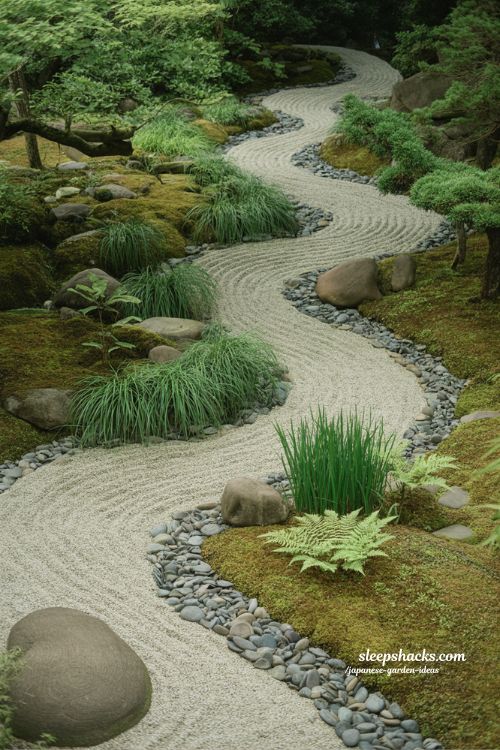
A dry stream bed, or karetaki, uses river pebbles, smooth stones, and carefully placed boulders to create the impression of a flowing watercourse — no water required. It’s a brilliant solution for gardens where a pond isn’t practical but where the visual presence of water is deeply desired. Line the ‘stream’ bed with smaller pebbles and place larger boulders at the ‘bends’ where a real stream would deposit heavier material. Plant Japanese forest grass and ferns along the banks for a complete naturalistic illusion.
- Grade pebble size naturally — larger stones at the outside of bends, finer gravel at the centre
- Plant Japanese iris near the stream edge to reinforce the water association through its bog-garden heritage
- Add a bamboo bridge or simple stepping stones crossing the stream for authentic charm and visual interest
11. Bamboo Screening for a Private Garden Room
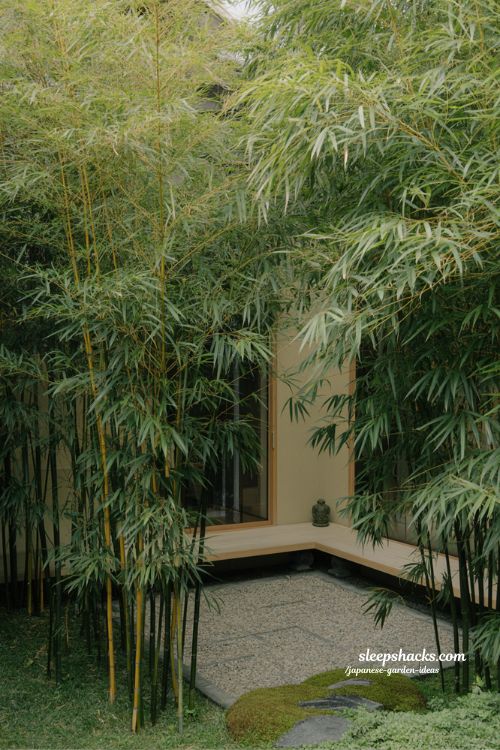
Bamboo creates some of the most beautiful natural screening available — architectural, evergreen, and deeply authentic to the Japanese aesthetic. For UK and temperate gardens, clump-forming Fargesia species are the smart choice. They provide graceful arching canes, year-round movement and sound in the wind, and dense screening without the invasive root system of running bamboos. A bamboo screen gives a garden room its walls, creating the sense of an enclosed, intentional space separate from the rest of the outdoor world.
- Always install a 60cm-deep root barrier before planting any Phyllostachys running bamboo species
- Fargesia murielae and F. nitida are the most reliable non-invasive choices for temperate climates
- Thin old canes at the base annually to keep the planting looking fresh, airy, and well-maintained
12. A Japanese Courtyard Garden for Urban Spaces

The tsubo-niwa, or courtyard garden, is a Japanese garden style purpose-built for small and urban spaces. A few carefully chosen elements — a single acer, a stone lantern, a gravel bed, and a cluster of moss — create a complete composition in a space as small as two square metres. The key is ruthless editing. Remove anything that doesn’t serve the composition. What remains should feel inevitable and perfectly placed, like it grew exactly where it was meant to be from the very beginning.
- Choose one focal point only — one plant, one stone, or one lantern — and build the composition around it
- Use a single material for the ground plane: raked gravel, moss, or pebbles — never a mix of all three
- Paint or stain surrounding walls or fencing in neutral grey, charcoal, or white to frame the garden composition
13. Azaleas Clipped Into Karikomi Cloud Shapes
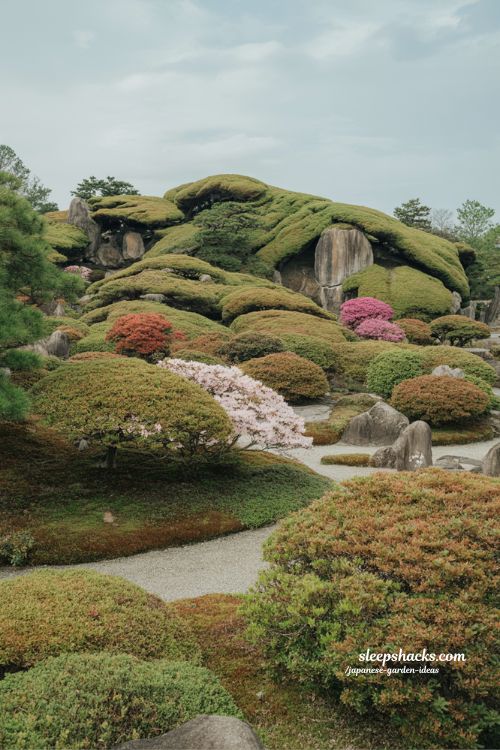
In Japanese gardens, azaleas are as valued for their clipping potential as for their flowers. The practice of karikomi — clipping azaleas into soft, rounded mounds — creates abstract landscape compositions that suggest rolling hills or mountain ridges in miniature. Planted in rows or flowing groups, clipped azalea mounds read as landscape rather than horticulture. Choose Japanese species like the Kurume hybrid group for the most authentic flowering character, and don’t rush the clipping — it improves every year as plants fill out.
- Clip azaleas once after flowering in early summer — avoid late pruning which removes next year’s buds
- Acid soil is essential; use ericaceous compost for planting and mulching in neutral or alkaline conditions
- Allow flowers to remain during spring blooming season rather than clipping mid-flower for a clean look
14. Japanese Forest Grass Along a Stone Path
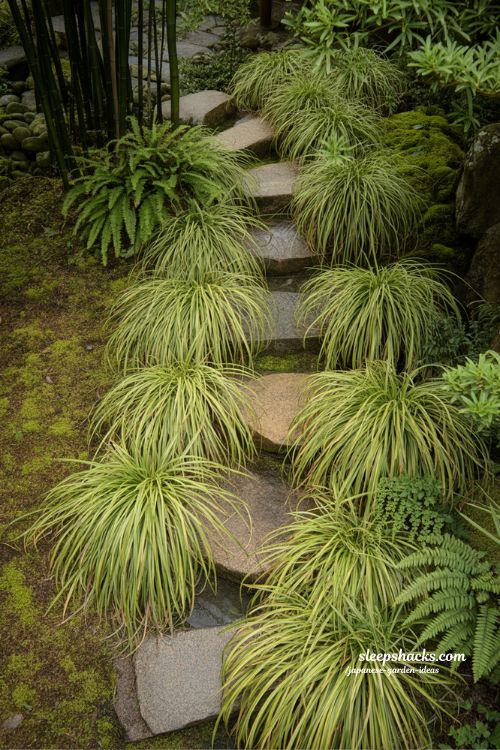
Hakonechloa macra — Japanese forest grass — is one of the most beautiful and underused plants for a Japanese-inspired garden. Its soft, arching habit cascades like a waterfall of fine foliage, with the ‘Aureola’ variety offering luminous gold-green variegation that brings extraordinary light to shaded spots. It grows naturally along stream banks on Japan’s mountain slopes, making it an authentically Japanese choice. As path edging against dark bamboo and stone, it creates a ground-level contrast of remarkable delicacy and grace.
- Plant in partial shade for the best gold variegation; full sun fades the foliage and reduces impact
- Allow it to cascade naturally over the lip of a path edge or raised bed — don’t trim the arching habit flat
- Pair with dark-leaved Japanese painted fern for a ground-level combination that looks genuinely extraordinary
15. A Tea House or Garden Pavilion as a Destination
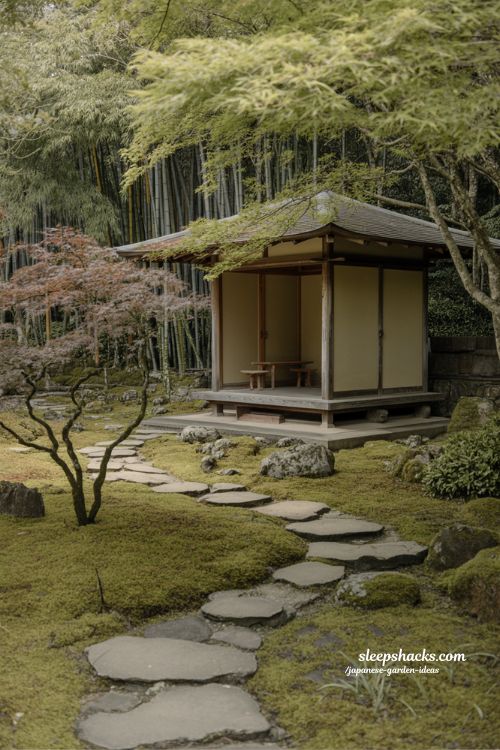
The traditional Japanese garden is always a journey, not just a view. And every journey needs a destination. A timber tea pavilion, a covered seating structure, or even a single well-placed bench at the end of a winding path gives the garden purpose. The structure is where the walk ends and the contemplation begins. It doesn’t need to be large — in fact, smaller is usually better. A simple roof, a timber floor, and a view back across the garden is everything you need.
- Position the pavilion or seat so it faces back into the best garden composition, not outward toward the boundary
- Use natural timber with a dark stain or natural weathering treatment to keep the structure grounded
- Frame the view from the seat with a carefully placed acer or bamboo clump that changes with each season
16. A Koi Pond With Stone Bridges and Planting
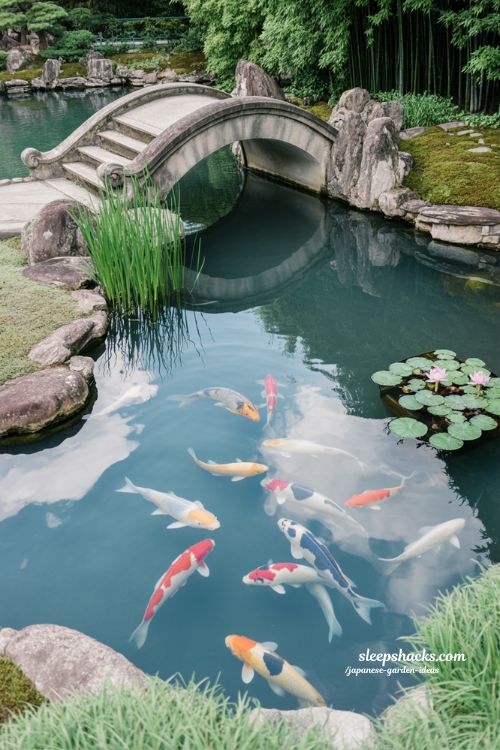
Water in a Japanese garden represents the ebb and flow of life itself. A koi pond with stone edging, a small arched bridge, and water-side planting of Japanese iris, lotus, and bamboo creates one of the most immersive and authentic Japanese garden experiences possible. Keep the water surface clear and reflective — resist the urge to fill it with floating plants. The mirror of sky and overhanging branch is the visual the pond is designed to create. Stillness is its own kind of beauty.
- Place larger stones at the pond edge to create a natural-looking bank rather than a hard formal edge
- Add lotus and Japanese iris in submerged containers to control spread while maintaining an authentic planting character
- Koi require water filtration and regular maintenance — budget for this before committing to fish in the pond
17. Winter Interest Through Bark, Berry, and Structure
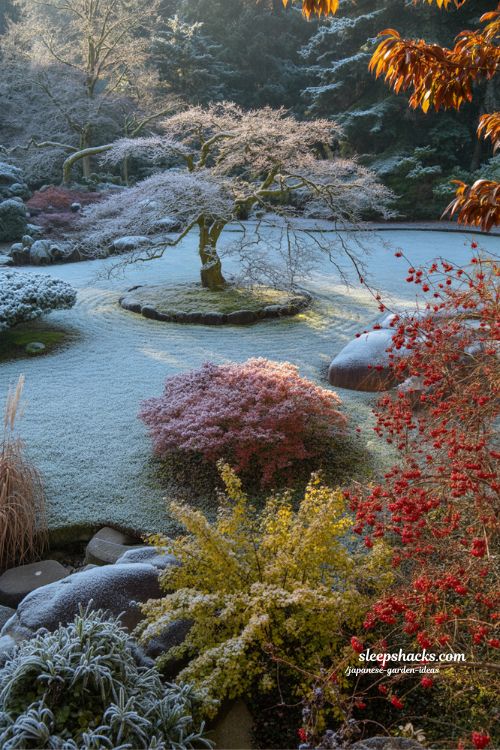
A Japanese garden doesn’t go dormant in winter — it transforms. The bare branch structure of a Japanese maple against a frost-covered gravel bed is as beautiful as its autumn colour. Skimmia provides jewel-bright red berries. Nandina domestica turns vivid crimson-orange. Mahonia flowers with intensely fragrant yellow blooms through December and January. Japanese wineberry glows with bristly red stems. Winter reveals the bones of a Japanese garden — and if those bones are good, the garden earns its beauty every single month.
- Leave miscanthus grass standing through winter — the frosted plumes are among the finest structural elements available
- Use Prunus serrula for its polished mahogany bark that catches low winter light with extraordinary warmth
- Resist the urge to cut back too early in spring — winter structure has value right up until new growth begins
Japanese Garden Style Comparison Table
| Idea | Best Garden Size | Maintenance | Water Needed | Skill Level |
|---|---|---|---|---|
| Zen Rock Garden | Any | Low | No | Beginner |
| Bamboo Water Feature | Small–Medium | Low | Yes | Beginner |
| Japanese Maple Focal Point | Any | Low | No | Beginner |
| Cloud-Pruned Shrubs | Any | High | No | Advanced |
| Stepping Stone Path | Any | Low | No | Beginner |
| Moss Garden | Small–Medium | Medium | No | Intermediate |
| Stone Lanterns | Any | Low | No | Beginner |
| Cherry Blossom Tree | Medium–Large | Low | No | Beginner |
| Wisteria Pergola | Medium–Large | High | No | Intermediate |
| Dry Stream Bed | Medium–Large | Low | No | Intermediate |
| Bamboo Screening | Any | Medium | No | Intermediate |
| Courtyard Garden | Small | Low | No | Beginner |
| Karikomi Azaleas | Medium–Large | Medium | No | Intermediate |
| Japanese Forest Grass | Any | Low | No | Beginner |
| Tea House / Pavilion | Medium–Large | Low | No | Advanced |
| Koi Pond | Large | High | Yes | Advanced |
| Winter Structure | Any | Low | No | Beginner |
FAQ
What Are the Most Important Elements of a Japanese Garden?
The three non-negotiables are rocks, plants, and a sense of journey. Water — either real or symbolised with gravel — is the fourth. Every element should carry meaning: rocks represent mountains, moss represents time, paths represent life’s journey. If you can’t explain why something is in the garden, it probably shouldn’t be there.
How Do I Start a Japanese Garden on a Small Budget?
Start with raked gravel, three good rocks, and a single Japanese maple. These three elements alone create a complete Japanese garden composition. Add a stone lantern and some clump-forming bamboo when the budget allows. The most celebrated Japanese gardens in Kyoto achieve extraordinary impact with almost no plants at all — restraint is free.
Which Plants Are Essential for Japanese Garden Ideas?
Japanese maple, bamboo (Fargesia for non-invasive), moss, and Japanese forest grass form the core palette. Add camellia, osmanthus, azalea, and skimmia for four-season structure and colour. Cherry blossom is the signature seasonal flowering tree. Keep the colour palette anchored in green, with white and soft pink as seasonal accents only.
Do Japanese Gardens Require a Lot of Maintenance?
More than most garden styles, yes. Cloud-pruned specimens need twice-yearly clipping. Raked gravel needs re-raking after rain. Moss needs moisture management. Bamboo needs occasional thinning. The minimalist appearance is achieved through constant, precise attention — not neglect. Budget time realistically before committing to the style.
Can I Create a Japanese Garden on Clay Soil?
Yes. Acers, bamboo, fatsia, and miscanthus all grow well on clay. For acid-loving plants like camellias, pieris, and azaleas, use raised beds with ericaceous compost. Improving drainage with grit and organic matter before planting is the most important step — waterlogging is the main risk on clay, and acers particularly dislike it.
What Is the Difference Between a Zen Garden and a Japanese Garden?
All zen gardens are Japanese gardens, but not all Japanese gardens are zen gardens. A zen garden (karesansui) specifically uses raked gravel and rocks to represent water and landscape without any actual water or large planting. A broader Japanese garden includes water features, paths, trees, pavilions, and more complex planting — it’s a full landscape design rather than a purely abstract composition.
How Do I Add a Japanese Feel Without Redesigning the Whole Garden?
Start with one strong element: a Japanese maple, a stone lantern, or a raked gravel bed. These single additions shift the feel of a space immediately. Remove any brightly coloured bedding plants near the new element — the contrast will undermine the effect. Work gradually, adding one considered piece at a time, and let the Japanese aesthetic grow into the space organically over one or two seasons.