

There’s a moment when you’re standing in your backyard, staring at a blank patch of grass or an outdated patio, and you just know — this space could be so much more.
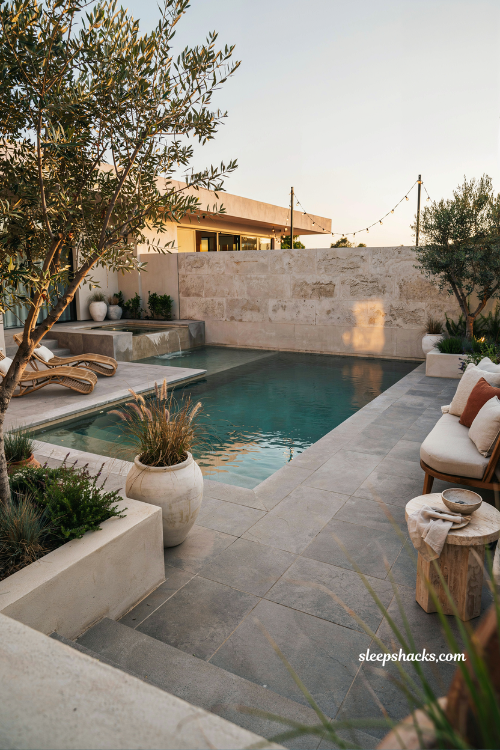
A modern pool design doesn’t just add a place to swim. It completely changes how you live outside. It becomes the reason you invite people over, the reason you stay home on weekends, the reason your house finally feels finished. And the good news? Whether your yard is large or tiny, a flat lot or a sloped one, there’s a modern pool design out there that will work beautifully for your space.
- Modern pool design prioritizes clean lines, intentional materials, and features like built-in spas, sun ledges, and water features.
- The right tile, plaster color, and decking material can dramatically change how your pool water looks — from dusty blue to deep teal.
- With good planning, even compact backyards can accommodate a thoughtfully designed modern pool that feels luxurious.
Why Modern Pool Design Is Worth Planning Carefully
A pool is one of the most significant investments you’ll make in your home. Getting the design right from the start — the shape, the materials, the features, the lighting — saves you from expensive regrets later. Modern pool design specifically rewards careful planning because the whole aesthetic depends on intentional decisions working together. A clean rectangular shape paired with the wrong tile color, for example, can lose that sleek look entirely. The magic is in the details.
| Feature | Budget Range | Visual Impact | Best For |
|---|---|---|---|
| Geometric rectangle | $ | High | Most backyards |
| Infinity edge | $$$ | Very High | Elevated/scenic lots |
| Sun ledge | $ | Medium | Families, lounging |
| Built-in spa | $$ | High | Year-round use |
| Sheer descent waterfall | $$ | High | Focal point walls |
| LED smart lighting | $$ | Very High | Evening entertaining |
| Natural stone decking | $$ | High | Premium look |
17 Modern Pool Design Ideas That Are Genuinely Worth Saving
1. The Clean Rectangular Pool That Never Goes Out of Style
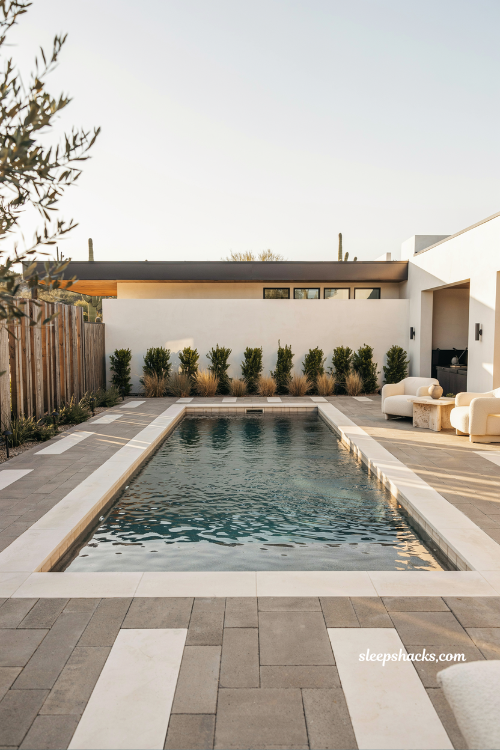
If you’re drawn to modern design, a simple rectangle is your best friend. Clean geometry, straight lines, and a shape that photographs beautifully from every angle — it’s a timeless choice that pairs well with almost any backyard setting. Award-winning contemporary homes, like the Paradise Valley project by Drewett Works, demonstrate how a rectangular pool becomes the visual anchor of an entire outdoor living space when paired with the right materials.
Choose your coping and decking carefully with a rectangular design — the straight lines mean everything is on display. Light limestone or porcelain pavers in a subway or stacked pattern complement the modern feel without competing with it.
- Opt for straight-edge coping rather than rounded bullnose for a sharper, more modern look.
- Keep surrounding plantings low and structured — nothing interrupts clean lines like overgrown shrubs.
- Use a consistent tile pattern around the full perimeter for a polished, intentional finish.
2. The Infinity Edge Pool for a Dramatic Backyard Statement
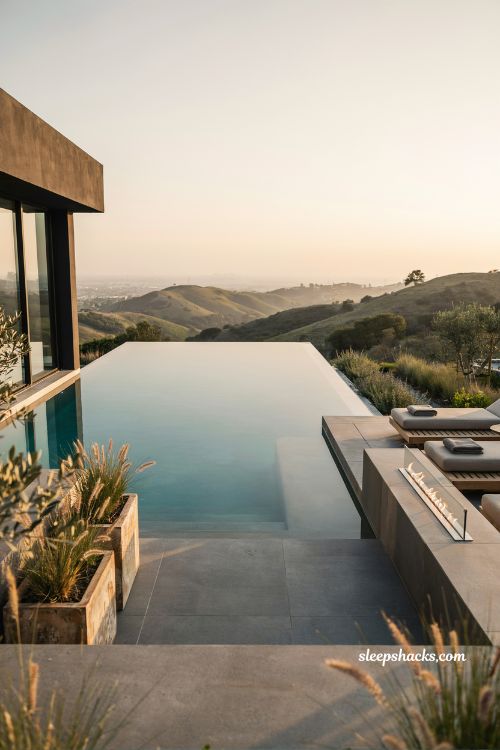
An infinity edge pool creates the illusion that your pool water flows endlessly into the landscape beyond it. It’s genuinely one of the most visually striking things you can do with a pool, and it works especially well on elevated lots or backyards with an open view — waterways, golf courses, or hillsides. The visual effect is at its best when you pair the edge with darker stone-look tiles that enhance reflections and depth.
The practical reality is that infinity edges cost more to build and maintain, but for the right property, that investment is completely justified. If your yard has a natural slope or a scenic backdrop, this is the design to seriously consider.
- Darker plaster colors deepen the mirror effect at the infinity edge.
- Position the vanishing edge toward your best view — typically facing away from the house.
- Make sure your pool builder has specific experience with infinity edge construction.
3. A Built-In Spa That Actually Gets Used
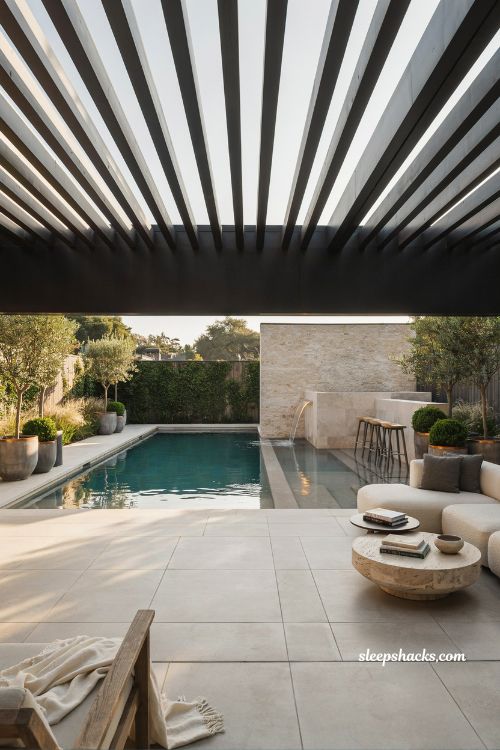
Most people who skip the spa regret it. A built-in spa integrated into your pool design extends your outdoor living season dramatically — and for those in cooler climates, keeping the spa separate with its own controls means you can run it well into the colder months when the main pool is closed. Placing the spa slightly elevated above the pool deck, with water overflowing into the pool when not in use, creates a beautiful visual effect and a natural gathering spot.
From a design standpoint, the spa’s placement matters a lot. Centering it on one of the shorter walls of a rectangular pool gives you symmetry and makes it feel intentional. An elevated spa can also create the perfect “bar counter” height if you’re adding in-pool bar stools along its edge.
- Choose a spa size that fits the number of people who’ll regularly use it — a 7×7 spa comfortably seats 4–6 adults.
- Add a separate light option so your spa can glow a different color than the main pool.
- Consider spa jets that overflow water gently into the pool even when the spa isn’t heating.
4. The Sun Ledge That Makes Pool Days Last Longer
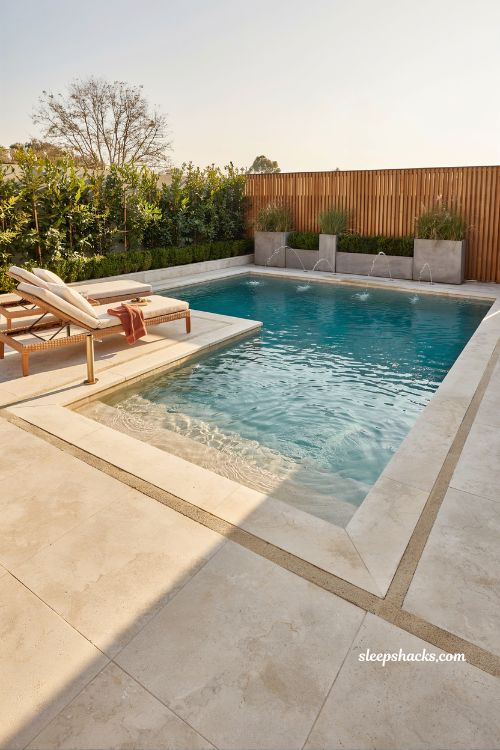
A sun ledge — sometimes called a tanning shelf or baja shelf — is a shallow, flat area at one end of the pool, typically 12 inches deep. It’s where you put a chaise lounge chair partially submerged in water, let the kids splash around safely, or just stand and feel the cool water without diving in. For families especially, it’s one of the most-used features of the entire pool.
Plan your ledge at least 7 feet wide if you want to fit full-size in-pool loungers. Consider adding umbrella sleeves directly into the ledge so you have the option of shade without hauling a freestanding base over each time.
- A 12-inch depth is ideal for most in-pool furniture brands.
- Position the ledge toward the end of the pool that gets the most sun throughout the day.
- Add deck jets or bubblers on the ledge for a water feature that also delights kids.
5. Minimalist Geometric Pool Design for a Sleek Finish
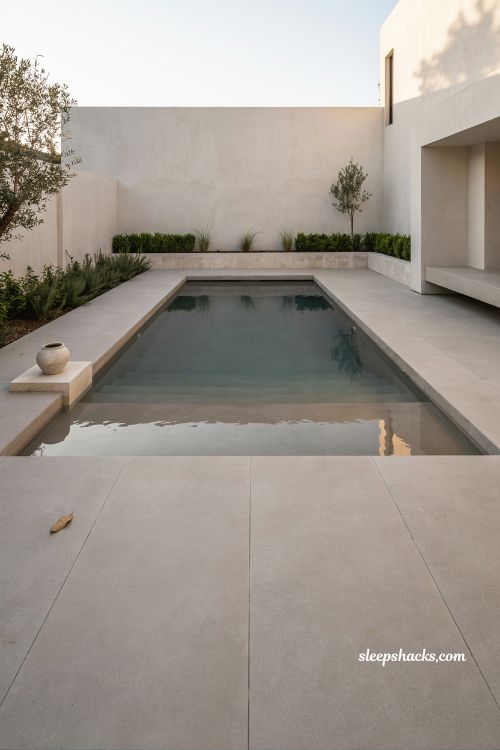
Minimalist modern pool design strips everything back — no unnecessary curves, no decorative tile borders, no fussy details. What’s left is structure, material quality, and intentional simplicity. Large-format matte-finish vitrified tiles with concrete-inspired textures pair perfectly with this approach, giving the pool an architectural quality that looks just as impressive up close as it does in photos.
The key to pulling off minimalist design is consistency. Every material choice needs to feel like part of the same visual language. Light decking with a darker pool interior is a classic minimalist pairing that creates striking contrast without any decoration at all.
- Use consistent grout color throughout — a medium gray ties everything together without fading into the tile.
- Avoid mixing too many stone types — pick one and commit to it for coping and decking.
- Matte finishes on tiles reduce glare and age better than high-polish surfaces in outdoor settings.
6. Natural Stone and Timber Decking for an Organic Modern Look
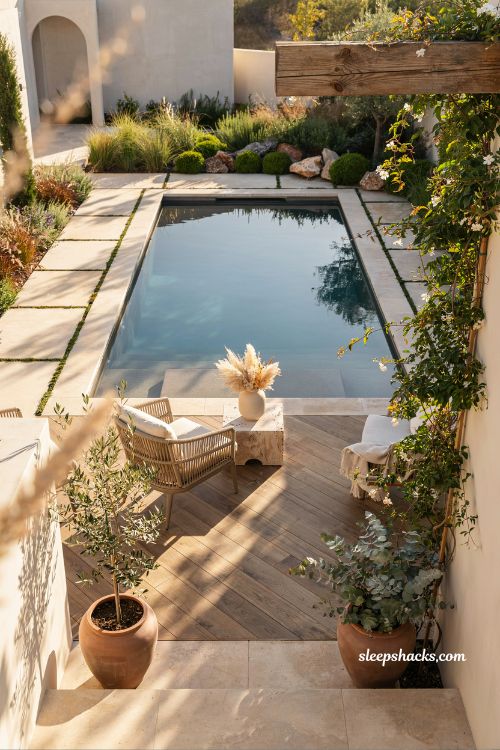
Not all modern pools need to feel cold or industrial. Natural stone finishes and timber or treated wooden decks add warmth to a modern design without sacrificing the clean aesthetic. Textured stone-effect tiles with anti-skid finishes work beautifully here — they’re safe around water and blend naturally with surrounding garden beds and landscaping.
This style suits backyards that lean toward a warm, relaxed outdoor living feel. It works especially well in homes surrounded by mature trees or lush planting, where the organic textures of stone and timber feel like a natural extension of the landscape.
- Choose anti-skid stone-effect tiles specifically rated for outdoor wet areas.
- Seal natural stone annually to protect against water absorption and staining.
- Timber decking near pools should be hardwood or composite — standard pine won’t hold up.
7. Dramatic Pool Lighting That Transforms the Backyard at Night
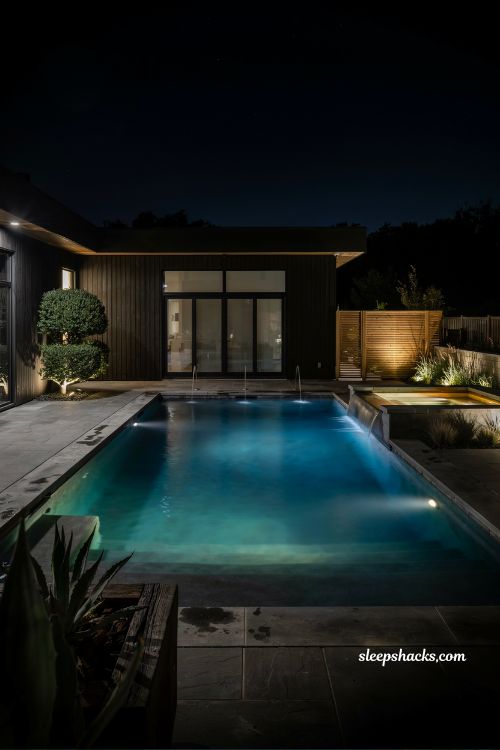
A pool at night with good lighting is a completely different experience from the daytime version — and it’s one of the most underrated parts of pool design. Underwater LED lights, illuminated spa edges, deck jets with built-in LEDs, and strip lighting along waterfall features can all be controlled via a smartphone app in most modern systems. The right light placement makes the water glow rather than just illuminate it.
The general rule is to place pool lights on the same side of the pool as the house so the light shines into the water rather than back into your eyes. If you entertain frequently near the water or on a dock or patio facing the pool, you can adjust this placement accordingly.
- Request smart control lighting so you can adjust colors and zones from your phone.
- A separate light for the spa lets you run two different colors at once for visual drama.
- LED deck jets and bubbler lights are worth the upgrade — they look spectacular at night.
8. A Sheer Descent Waterfall as the Pool’s Focal Point
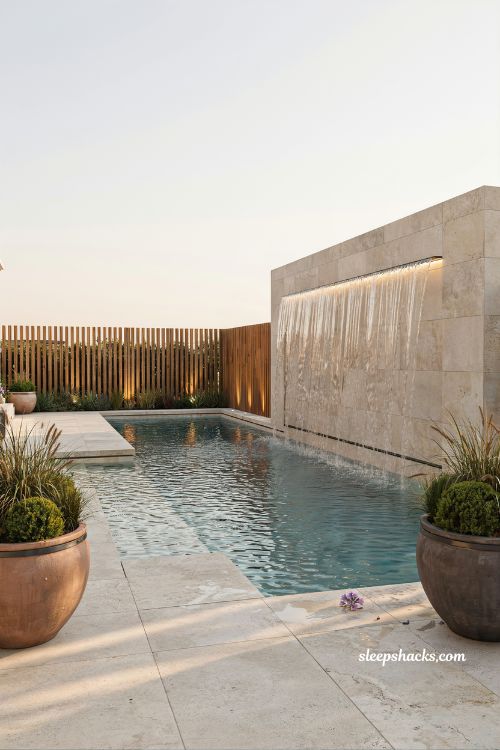
A sheer descent waterfall is a flat, glass-like curtain of water that falls from a raised wall into the pool below. It’s architectural, dramatic, and has a genuinely calming sound. Building the waterfall wall a foot or two taller than standard gives you more of a visual anchor — and if you add an LED strip light inside the waterfall, the nighttime effect is something else entirely.
For modern pool designs, the sheer descent works especially well on the short end of a rectangular pool, turning an otherwise plain wall into a statement feature. It pairs naturally with a sun ledge on the opposite end so the pool has two distinct focal points.
- A 48-inch wide sheer descent is a common size that works well for most rectangular pools.
- Choose a waterfall wall material that matches your coping for a cohesive look.
- Sheer descents with built-in LED lighting are worth the extra cost for evening impact.
9. Light-Toned Decking That Makes Small Pools Feel Bigger
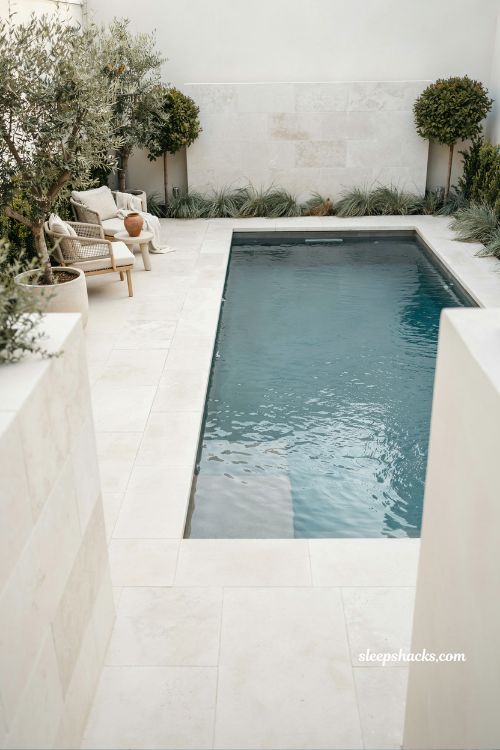
One of the smartest tricks in modern pool design for smaller backyards is choosing light-colored decking. White shell limestone, light porcelain pavers, and ivory travertine all reflect sunlight and make the surrounding space feel open and airy rather than closed in. Paired with a darker plaster interior — deep blue or gray — the contrast is clean and striking.
Natural shell stone (limestone with actual shells in it) is slightly tougher than travertine, holds its light color well, and has a texture that feels comfortable underfoot. Porcelain pavers give a brighter, more modern look but require specialty cutting tools, which adds to labor costs.
- White or near-white decking visually expands a small pool area — especially important in compact yards.
- Choose a tumbled finish for a softer, more natural look, or a sawn finish for sharper modern lines.
- Make sure any decking material carries an anti-slip rating appropriate for wet outdoor use.
10. Compact Urban Pool Designs That Make the Most of Small Spaces
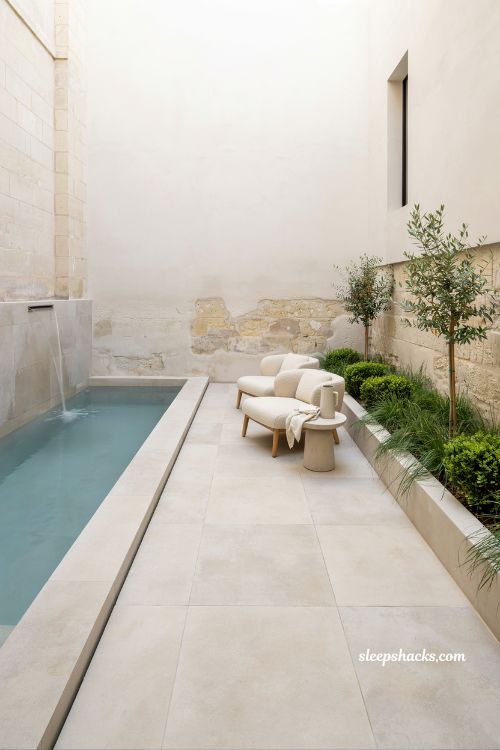
A small backyard doesn’t mean no pool — it means a smarter pool. Spool designs (spa-pool hybrids), plunge pools, and narrow lap pools all work beautifully in constrained spaces. The key is designing around the space honestly rather than trying to cram in a full-size pool. A 265 square foot backyard in South Tampa, for example, was transformed with a small spool offset to one side of the yard — leaving room for grass and maximizing the feeling of outdoor space.
Light-toned, full-body tiles reflect light in compact pool areas, making them feel open and larger than they actually are. Good lighting and a simple water feature can give a small pool just as much presence as a large one.
- Offset the pool to one side of the yard rather than centering it — this often creates more usable outdoor space.
- A heater on a small pool is especially worth it since you can reach temperature quickly.
- Keep decking simple and consistent to avoid visual clutter in a tight space.
11. Eco-Friendly Pool Design for the Sustainability-Minded Homeowner
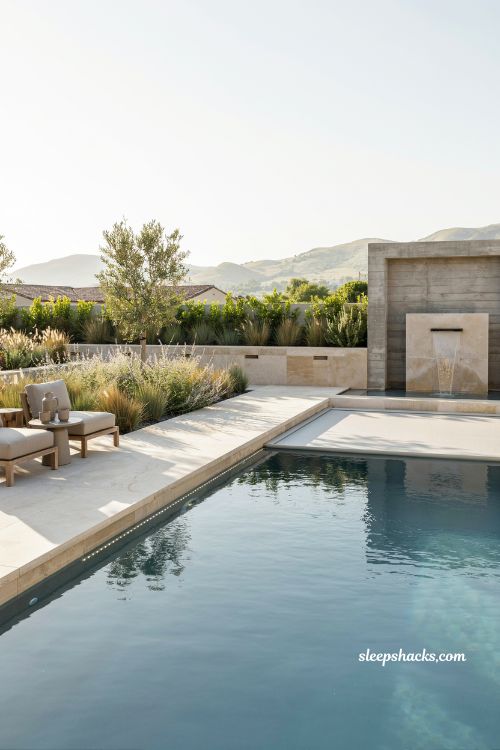
Modern pool design and sustainability aren’t mutually exclusive. Light-colored vitrified tiles reflect more sunlight and help maintain a comfortable water temperature without as much heating. LED lighting consumes significantly less energy than traditional pool lights. Efficient filtration pumps, pool covers to reduce evaporation, and eco-friendly cleaning products all contribute to a pool that’s kinder to both the environment and your energy bills.
The visual result of an eco-conscious design can be just as beautiful as any other — in fact, the clean, minimal aesthetic common in green design pairs perfectly with modern pool aesthetics.
- Use a pool cover when the pool isn’t in use — it reduces water evaporation significantly.
- Variable-speed pumps use far less energy than single-speed models and are worth the upfront cost.
- LED lights use up to 80% less energy than halogen equivalents and last far longer.
12. Patterned Mosaic Pool Tiles for Visual Interest
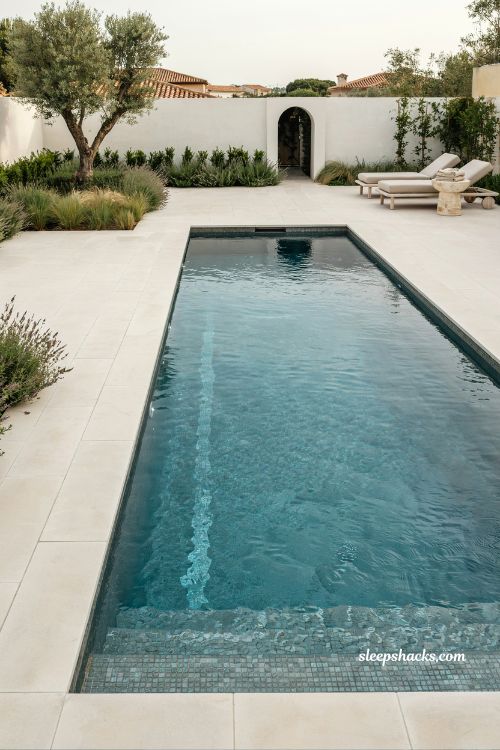
If you want your pool to have personality without breaking the clean modern aesthetic, mosaic tile is the way to do it. A band of mosaic tile along the waterline — especially in a deep blue-gray or iridescent finish — adds depth and visual interest without overwhelming the design. Mosaic tiles with a slightly iridescent quality change character depending on the light and time of day, which makes them endlessly interesting.
Just don’t choose your mosaic tile from photos alone. The same tile can look completely different in person depending on lighting conditions. Always view samples in natural daylight before making a final decision.
- Mosaic waterline tiles should complement your plaster color — hold samples together and check in both sun and shade.
- An iridescent mosaic adds subtle shimmer without looking decorative or busy.
- The way mosaic tiles are laid — stacked vs. offset — changes the final look significantly.
13. Rooftop Pool Design for Apartments and Vertical Spaces
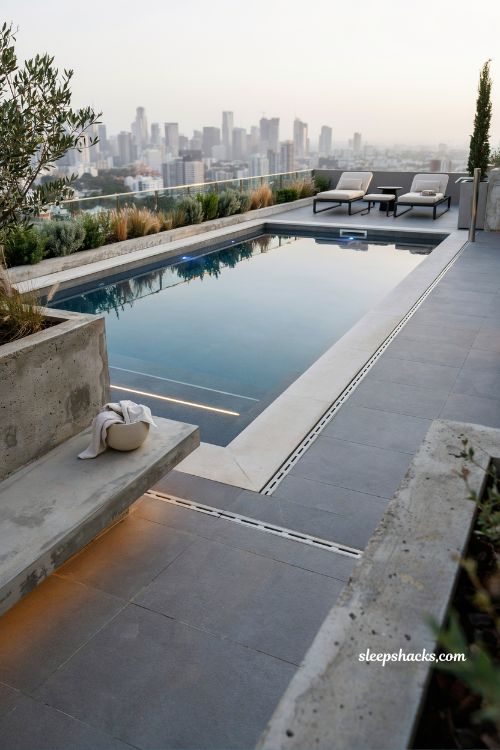
Rooftop pools represent one of the most creative uses of vertical space in modern architecture. For apartment buildings or homes with rooftop terraces, a well-designed rooftop pool with weather-resistant anti-skid tiles, smart drainage, and LED lighting can create a genuinely impressive outdoor space where none seemed possible. Material choices matter even more here — direct sunlight, rain exposure, and heavy use demand tiles that hold up.
Matte, anti-skid finishes on outdoor tiles are non-negotiable in rooftop settings. They perform better under direct sun, age more gracefully than glossy alternatives, and are far safer when wet.
- Waterproofing the rooftop structure before installation is critical — consult a structural engineer.
- Choose tiles rated for heavy outdoor use with a proven slip resistance standard.
- Keep the design minimal — in a compact rooftop space, simplicity reads as luxury.
14. Indoor Pool Design for Year-Round Swimming
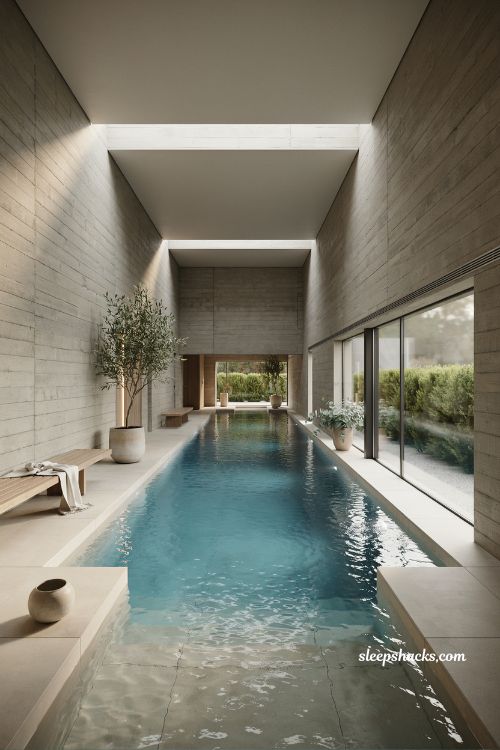
An indoor pool removes every weather excuse from the equation. Whether it’s rain, cold, or harsh summer sun, an indoor pool design gives you a private retreat that’s available all year. Anti-skid tiles, balanced lighting, and proper ventilation are the three non-negotiables. Moisture-resistant wall and floor finishes keep the space looking clean and prevent humidity-related damage over time.
From a design standpoint, indoor pools benefit enormously from natural light — skylights or full-height glazed walls connect the pool to the outdoors visually while maintaining the protected indoor environment.
- Ventilation is as important as any tile choice — consult a specialist to manage humidity and condensation.
- Use moisture-resistant paints and finishes on all walls and ceilings, not just the pool surround.
- Indoor pools with glass walls or skylights maintain a connection to natural light that prevents the space from feeling closed in.
15. Water Features Beyond the Waterfall: Deck Jets and Bubblers
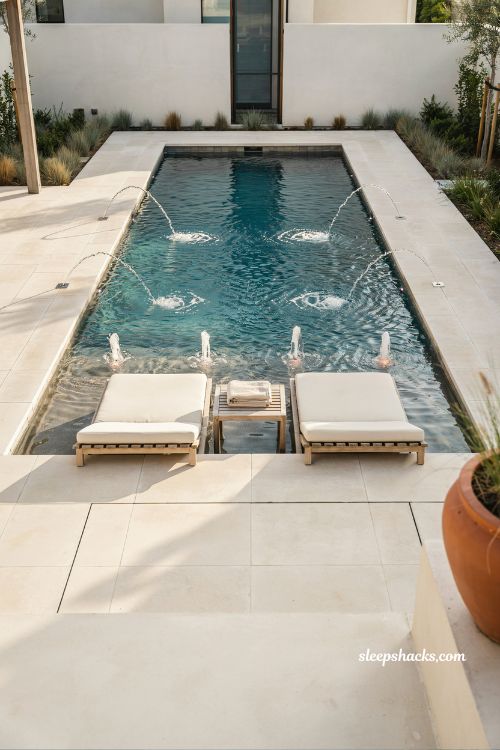
Deck jets — arcing streams of water that shoot from the pool deck into the pool — and bubblers on sun ledges are two underrated modern water features that add movement and sound without taking up space or overwhelming the design. Kids love running through deck jets. Bubblers on a sun ledge create a gentle, playful water effect perfect for sitting with toddlers. Both can be fitted with LED lights for nighttime effect.
These features work best when they’re integrated into the original pool design rather than added as an afterthought. Placement needs to be planned around where people will be sitting, swimming, and moving.
- Two deck jets symmetrically placed on one end of the pool is a clean, modern arrangement.
- LED-lit deck jets look spectacular at night and cost relatively little to add at build time.
- Bubblers on sun ledges are especially worth it if you have young children who use the ledge frequently.
16. The Bi-Level Pool Design for Sloped Backyards
If your backyard slopes — especially toward a water view, lower yard, or garden level — a bi-level pool design works with the terrain rather than fighting it. The pool sits at the upper level, the edge of the pool becomes the retaining wall, and the lower yard remains functional as a separate outdoor space. This approach is typically more cost-effective than installing a full retaining wall across the entire yard and often produces a more interesting visual result.
An elevated spa at the bi-level junction becomes a natural gathering point and can create a bar-height seating area when in-pool bar stools are installed along the edge facing the lower yard.
- Have a landscape architect or pool designer produce renderings before committing — sloped yards are harder to visualize.
- Mark out the pool edges physically in your yard before finalizing the design — stakes and rope tell you more than a plan on paper.
- The bi-level design offers privacy from below while maintaining views from above.
17. Salt Water Pool with Smart Controls for Low-Maintenance Modern Living
Salt water pools use a chlorine generator that converts salt into chlorine — producing a gentler, more consistent sanitizing environment than traditional chlorine dosing. For modern homeowners who want a pool that largely takes care of itself, a salt water system paired with smart app controls (for lighting, temperature, filtration, and water chemistry monitoring) is about as close to effortless pool ownership as it gets.
The water feels noticeably softer on skin and eyes than traditional chlorinated pools, and the maintenance routine is simpler once the system is properly set up and balanced.
- Salt water systems still require regular testing — they aren’t truly zero-maintenance.
- Smart control systems let you monitor water chemistry, temperature, and lighting from your phone.
- LED pool lights are the ideal pairing with a smart control system — everything is adjustable remotely.
Modern Pool Design: A Quick Comparison Guide
| Pool Type | Best Yard Size | Budget Level | Key Feature | Water Color Tip |
|---|---|---|---|---|
| Rectangular geometric | Any | $ – $$$ | Versatility | Works with any plaster |
| Infinity edge | Large / elevated | $$$ | Vanishing edge | Dark plaster deepens effect |
| Spool / plunge pool | Small | $ – $$ | Compact footprint | Light tiles expand the space |
| Freeform | Large with landscape | $$ | Organic shape | Stone-look tiles blend in |
| Indoor pool | Any (enclosed) | $$$ | Year-round use | Light plaster keeps space bright |
| Rooftop pool | Rooftop terrace | $$$ | Urban luxury | Matte tiles for outdoor durability |
| Bi-level pool | Sloped yard | $$ | Retaining wall design | Elevated spa as focal point |
Frequently Asked Questions About Modern Pool Design
What Makes a Pool Look “Modern”?
Clean lines, geometric shapes, and intentional material choices are the main ingredients. A rectangular or L-shaped pool with straight-edge coping, a consistent tile treatment at the waterline, and a plaster color chosen to create a specific water tone — dusty blue, deep teal, or dark gray — gives you that unmistakably modern look. The surrounding decking and plantings matter too. Structured, low landscaping with light-colored stone paving reinforces the modern aesthetic.
What Is the Best Plaster Color for a Modern Pool?
Deep, dusty blue and charcoal gray are the most popular plaster choices for modern pools right now. The color you see in the water is influenced by the plaster pigment, the depth of the water, the surrounding reflections, and the time of day. Darker plastics produce a more dramatic, moody water color, while medium-toned blue-gray plasters create that popular “dusty blue” look even in shallow areas like sun ledges.
How Do I Choose the Right Pool Tile for a Modern Design?
Start with your plaster color and work outward. Your waterline tile should complement the plaster — holding physical samples together in natural light is the most reliable way to test this. For a modern look, subway tiles in a stacked (non-offset) pattern or large-format plain tiles give a sleek, architectural feel. Avoid highly decorative or patterned tiles unless you’re going for a specific Moroccan or Mediterranean design direction.
Is a Built-In Spa Worth the Extra Cost?
For most homeowners, yes. A built-in spa extends your outdoor living season, adds significant resale value, and becomes one of the most-used features of your pool once it’s in. If budget is a constraint, it’s generally better to simplify elsewhere (such as decking material or water feature complexity) than to skip the spa altogether.
What Pool Decking Material Works Best for Modern Pools?
Natural limestone, porcelain pavers, and large-format vitrified tiles are the top three choices for modern pool decking. Light-colored options in the 12×24 or larger format work especially well — the lighter the deck, the more it contrasts with the pool water and the more spacious the area feels. All materials used around pools must have anti-skid ratings appropriate for wet outdoor surfaces.
How Many Lights Does a Modern Pool Actually Need?
More than you might think. A standard-sized rectangular pool with a spa, sun ledge, and water features can easily require 10–15 lights to create a balanced, dramatic nighttime effect. Underwater pool lights, spa lights (ideally on a separate control), water feature lighting, and deck accent lighting all contribute to the overall atmosphere. Smart LED systems with app control give you the ability to adjust colors and zones without getting out of the water.
How Long Does It Take to Build a Modern Pool?
Pool construction typically takes four to eight weeks for the pool itself, but the full project — including decking, landscaping, fencing, and water features — often runs three to six months from design sign-off to final completion. Permitting timelines vary significantly by location and can add weeks to the schedule. Starting the design process as early as possible, especially if you have a specific seasonal deadline, is strongly recommended.